
Wormwood’s Unfinished Warning: When the State Enters the Mind
I began Wormwood, the Netflix documentary series, expecting a Cold War story about LSD, secrecy and a suspicious death. By the final credits, however, it had become a larger question: What happens when an institution meant to protect us treats the human mind as a site of operations and controls the evidence needed to understand its actions?
At the centre of the series is Frank Olson, a biochemist at the US Army’s biological-warfare laboratory at Fort Detrick. In 1953, he died after falling from a New York hotel window. Days earlier, CIA personnel had secretly given him LSD. That much is established. In 1975, the Rockefeller Commission reported that the CIA had administered behaviour-influencing drugs to unsuspecting people, ordered records destroyed, and conducted testing on citizens that was “clearly illegal.” Half a century later, a House task force returned to MKULTRA in June 2026, asking again about accountability, declassification, and missing records.
What happened in the hotel room is less certain. Whether Olson jumped, fell, or was pushed has never been authoritatively resolved. His family alleged assassination, but no court adjudicated that allegation. A 2013 lawsuit was dismissed on timeliness, settlement and sovereign-immunity grounds, not after a trial about what happened that night. This distinction is essential. Wormwood is both an investigation and an argument, it is not a judgment.
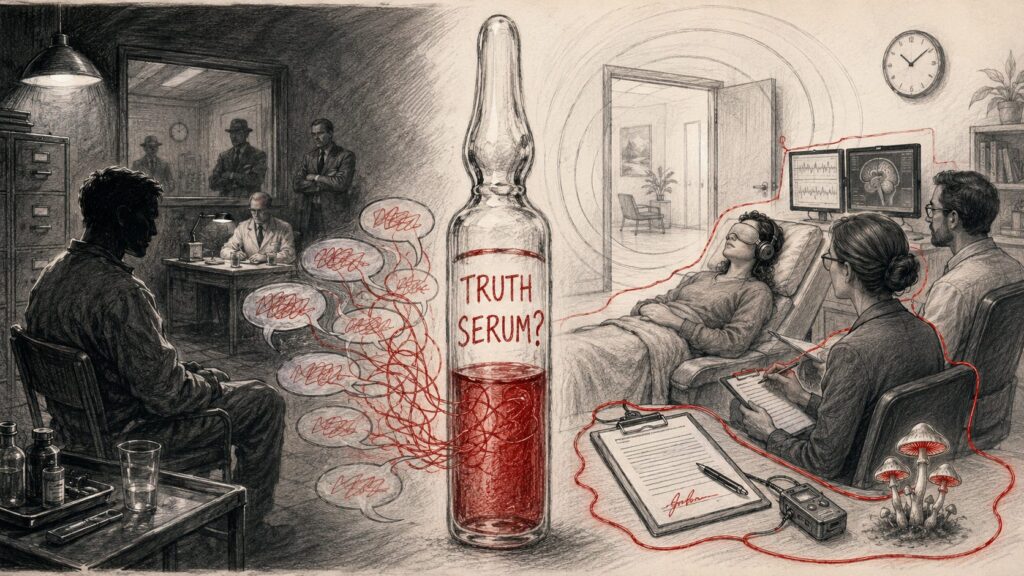
“Truth serum” was never really about truth
The phrase truth serum sounds almost quaint, as though scientists hoped to discover a liquid that made deception impossible. The reality was less elegant. The CIA studied scopolamine, barbiturates, and LSD because officials hoped that lowered inhibition, confusion, or suggestibility might assist interrogation. Yet the agency’s own study of “truth” drugs in interrogation acknowledged serious limitations. A person under the influence may speak more, but more speech is not more truth. It may be confused, invented, or shaped by the interrogator’s expectations.
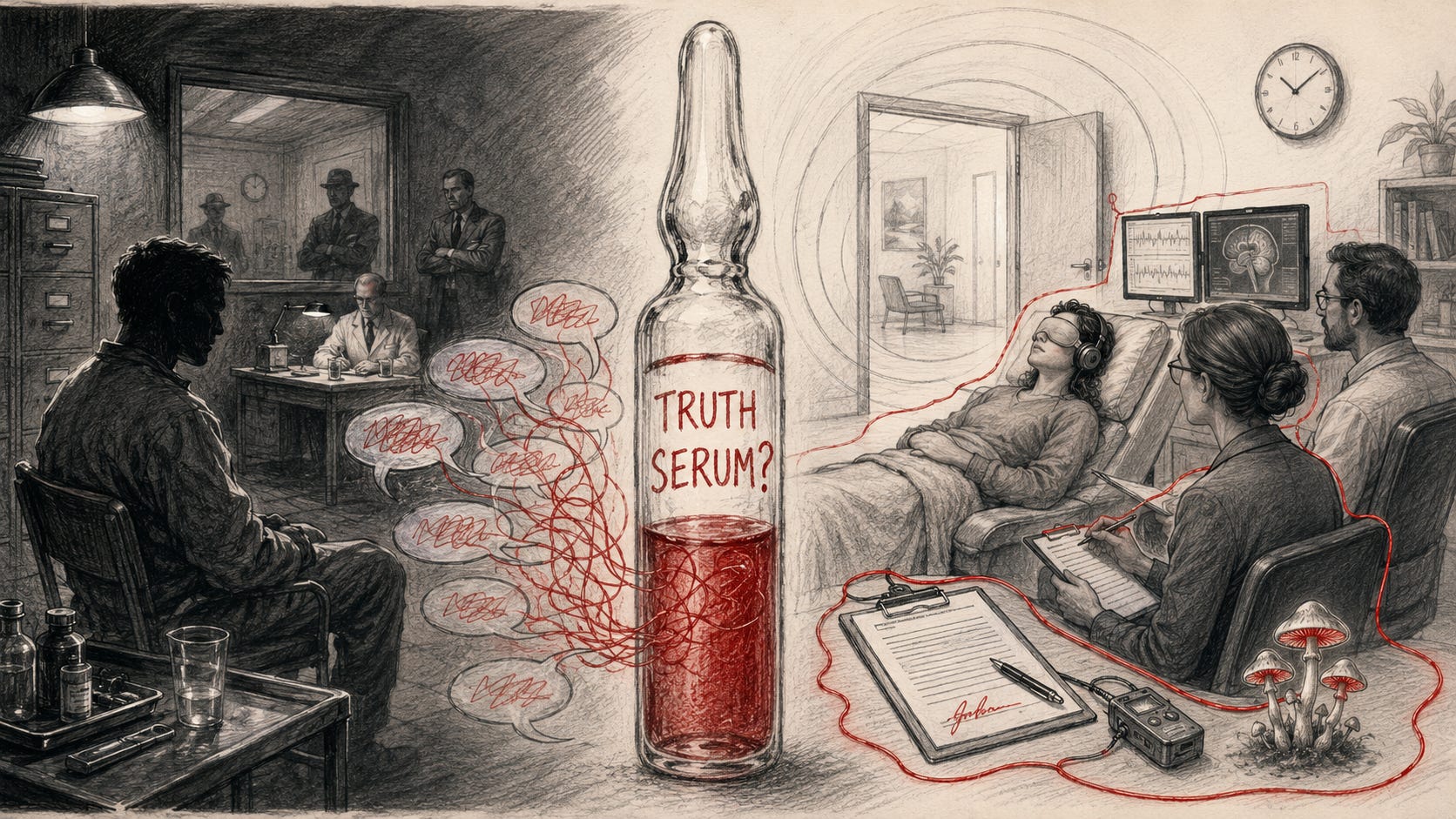
This is the first lesson I would carry from MKULTRA into today’s psychedelic renaissance. The danger did not reside in a molecule acting alone. It arose when a psychoactive substance was combined with secrecy, institutional authority, and a person who could not refuse. This does not make MKULTRA morally equivalent to contemporary psilocybin research. Modern clinical trials conducted under an investigational-new-drug application operate within FDA rules, institutional review and informed-consent requirements. Psilocybin remains federally investigational, and research involving a Schedule I substance must also satisfy controlled-substance rules.
The warning remains relevant because psychedelic experiences can change a participant’s relationship to authority in the room. The FDA’s July 2026 final guidance for psychedelic clinical investigations recognises functional unblinding, expectancy bias, therapist influence, and hours-long vulnerability. It recommends two monitors during dosing and says consent should address altered judgment and increased suggestibility. A September 2026 FDA hearing makes this a live policy question, not just a historical analogy.
This word, suggestibility, is the hinge. If a participant’s capacity to resist influence changes during a session, consent cannot be treated as a form signed once at the door. It must continue to govern the setting, the therapist’s words and touch, the recording and use of intensely personal disclosures, withdrawal, long-term follow-up and the commercial interests surrounding treatment. The central biolegal question is therefore not only “Did this person consent to taking psilocybin?” but also “What power did the researcher or therapist acquire once the drug took effect, and what limits followed that power into the room?”
Biological weapon, chemical weapon, or neither?
Wormwood also moves repeatedly between biological warfare and psychoactive chemicals. Because Olson worked at Fort Detrick, it is easy to place everything under the broad and frightening label of “biological weapons.” The law, however, does not put these substances into one box.
The Biological Weapons Convention (BWC), opened for signature in 1972 and in force since 1975, prohibits biological agents and toxins of types and quantities that lack a prophylactic, protective, or peaceful justification. This was a landmark convention and the first treaty to prohibit an entire class of weapons of mass destruction. But LSD and psilocybin are chemicals, not biological agents. The fact that LSD can be synthesised, while psilocybin originates in fungi, does not determine their legal classification.
The weaponisation of a psychoactive substance is therefore more naturally analysed under the Chemical Weapons Convention. Its “general purpose” test can cover any chemical that causes death, permanent harm, or temporary incapacitation through chemical action, unless its type and quantity fit a permitted purpose. Context is thus decisive: medical and pharmaceutical research may be permitted while exploiting toxic properties as a method of warfare is not. In 2021, states parties further agreed that aerosolised central-nervous-system-acting chemicals are inconsistent with law-enforcement purposes.
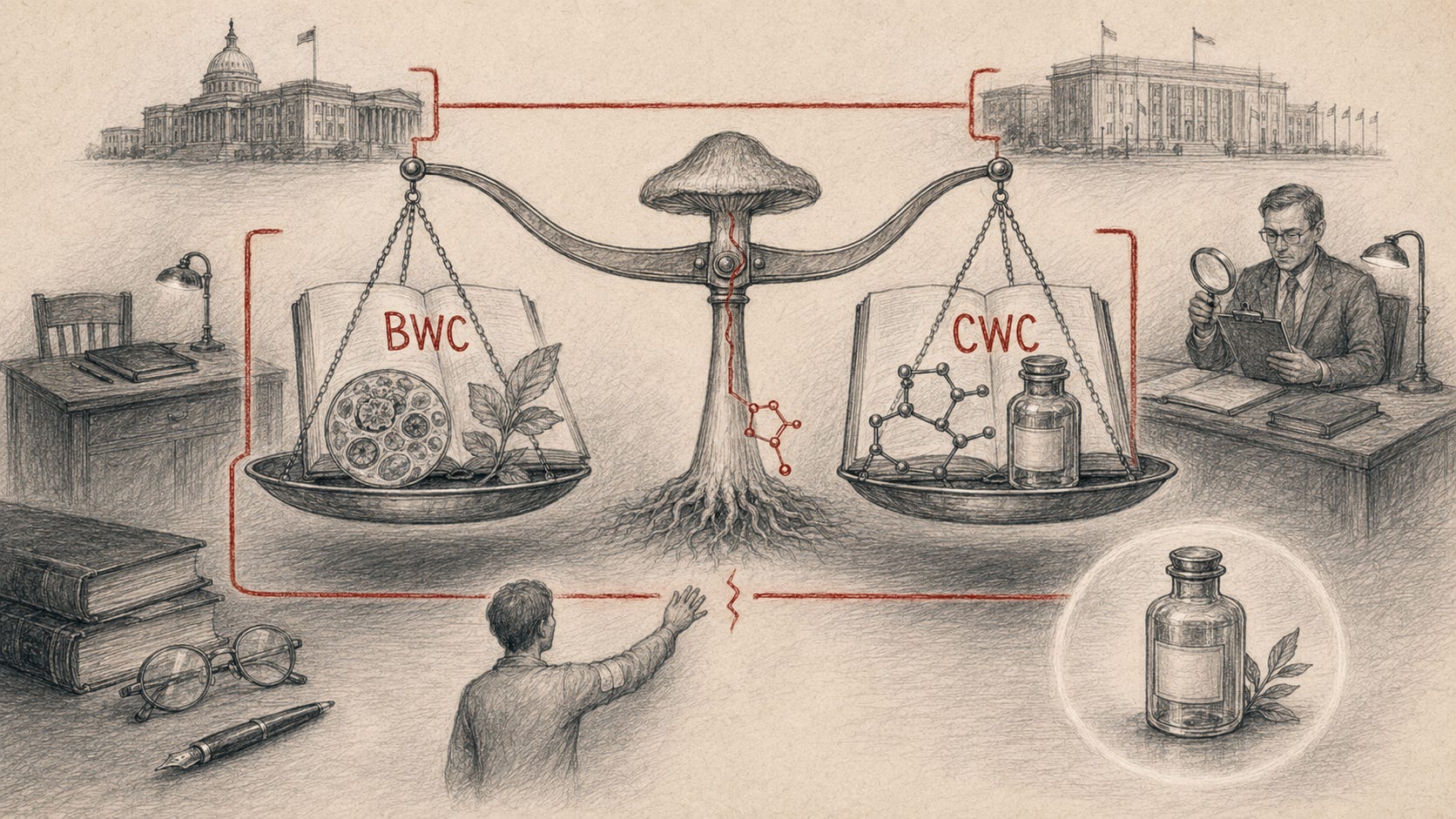
This legal sorting reveals a deeper problem. The BWC has no Organisation for the Prohibition of Chemical Weapons style standing verification organisation, routine inspection system or individual complaints procedure. A state may take a suspected breach to the UN Security Council, but a person who has been harmed cannot bring a BWC claim for damages. The prohibition between states is therefore much stronger than the remedy available to the body harmed by a state.
Who is responsible when the state commits the wrong?
That gap leads to an uncomfortable question: If a state violates an international rule, who is actually held responsible?
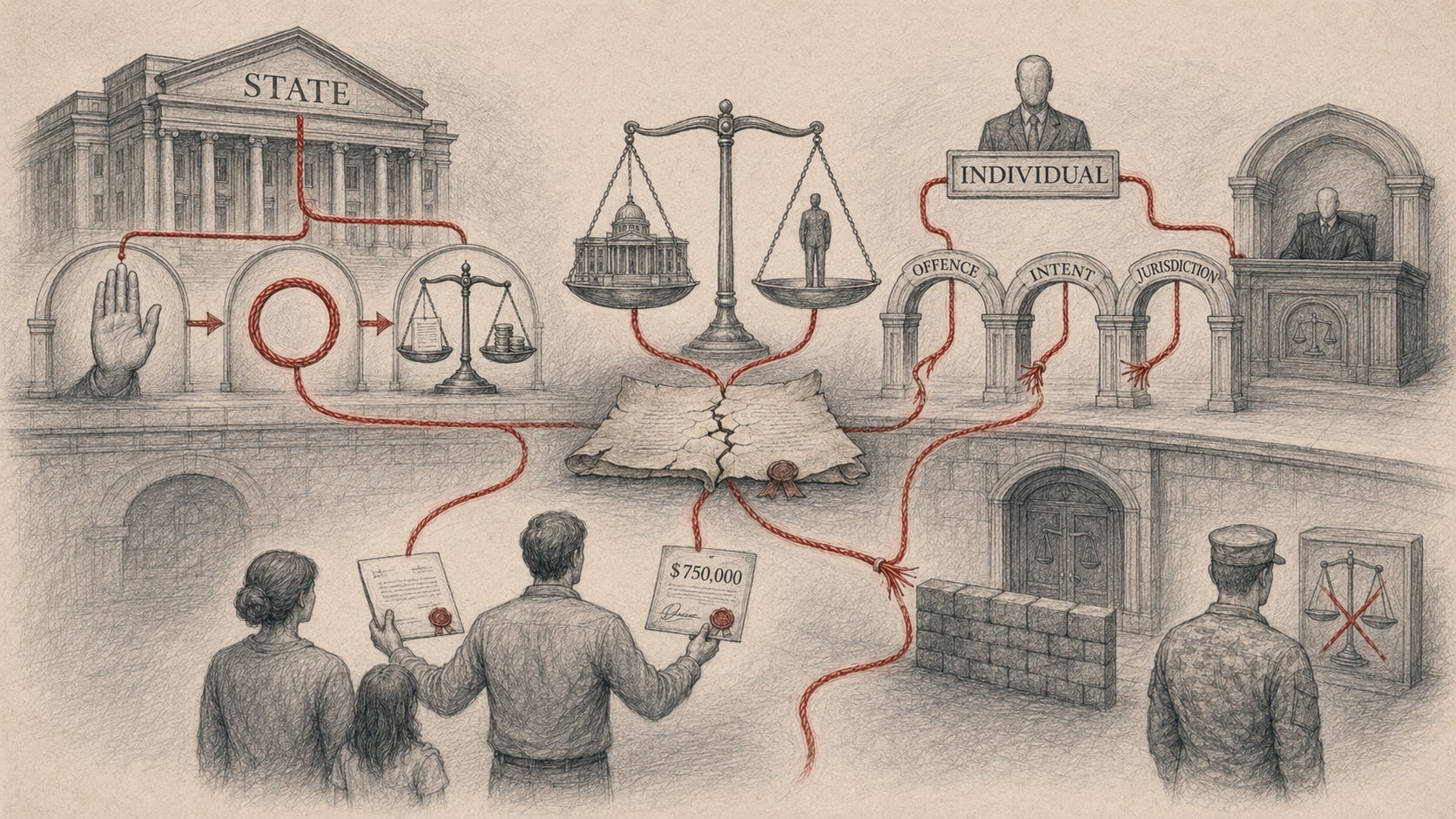
International law answers on two levels. Under the Articles on State Responsibility, conduct attributable to a state that breaches an international obligation may require cessation, non-repetition, and reparation. Criminal responsibility, by contrast, belongs to individuals who order, carry out, assist, or conceal crimes provided an offence and a court’s jurisdiction can be established.
We should not collapse these levels. Describing institutional conduct as criminal does not prove which person possessed the required intent. Nor does every non-consensual experiment automatically meet the Rome Statute’s threshold for a crime against humanity where the act must form part of a widespread or systematic attack directed against a civilian population, accompanied by the necessary knowledge. Experimentation may also amount to a war crime, but that generally requires a connection to armed conflict. Moral horror and legal category are not synonyms.
The Olson story shows how accountability can remain incomplete even when a government acknowledges wrongdoing. In 1976, Congress authorised a payment of $750,000 to his family, and President Ford said that the secret administration of LSD “would appear to have been a proximate cause” of Olson’s death. The compensation and apology recognised a wrong, but they did not produce a public trial, full discovery, or an authoritative finding about his death.
Army Master Sergeant James Stanley, another unwitting LSD subject, did reach the Supreme Court but in United States v. Stanley, the Court barred his damages claim because the injury was incident to military service. Again, we arrive at the same troubling place: A right may have been violated while a legal remedy remains out of reach.
The protections we have and the gaps between them
The United States did respond to the abuses exposed during the 1970s, but it did so through a mosaic of rules and regulations, rather than a single constitutional moment. The Privacy Act regulated federal systems of records. Congressional intelligence committees and the Foreign Intelligence Surveillance Act added oversight. The National Research Act led to the Belmont principles, while today’s Common Rule requires institutional review and informed consent for covered federally conducted or supported research. Separate FDA rules protect participants in FDA-regulated clinical investigations.
Some protections speak even more directly to the history. Federal law bars the Department of Defense from testing chemical or biological agents on civilians or other human subjects except for specified purposes, with advance informed consent and notice to Congress. Executive Order 12333 requires intelligence-community human research to follow federal health guidelines and to document consent. Internationally, Article 7 of the International Covenant on Civil and Political Rights prohibits medical or scientific experimentation without free consent.
On paper, this sounds substantial. In practice, the gaps remain visible. The Common Rule does not cover every privately funded study. An executive order may govern officials without giving a victim a damages action. Military claims can encounter the Feres doctrine; civilian claims may founder on sovereign immunity, filing deadlines or tort-law exceptionsl and classification and destroyed records can make proof almost impossible.
The newer frontier is the mind itself. Colorado now treats neural data as sensitive data, but the US still has neither an omnibus private-sector privacy law nor a general federal right to mental privacy or cognitive liberty. The US Government Accountability Office describes the wider privacy system accurately as a collection of sector-specific rules without an overarching law for the private sector.
When journalism reaches the locked door
This brings me back to the unease I felt while watching Wormwood. I have often thought that journalism gets closer to truth than law does. The series makes that belief almost irresistible. Law must ask whether a claim was filed in time, whether the sovereign consented to be sued, and whether admissible evidence proves every required element. Journalism can continue asking questions after a court has closed the case. It can place a destroyed file, an evasive statement, and a family’s grief in the same frame.
But journalism has limits. It cannot compel a remedy and does not always have discovery or cross-examination. Cinematic storytelling can make a hypothesis feel like a memory. Some critics admired Wormwood as a daring hybrid, while others argued that its four-hour sprawl and scripted reenactments turn an unresolved murder theory into a persuasive narrative. The series does not establish what happened, part of its power lies in making uncertainty feel unbearable.
That criticism belongs inside the legal analysis, not outside it. Wormwood is most valuable when watched as a case study in how knowledge is made, and unmade, under conditions of secrecy, rather than as proof of every theory it stages.
Journalism can preserve a question that law cannot answer. Law, when its doors open, can compel evidence and impose remedies that journalism cannot. Neither guarantees truth. The deepest failure begins when the state controls the experiment, the records, and the route to redress.
That, for me, is Wormwood’s unfinished warning. Modern protections make another secret LSD dosing far less legally defensible. They do not yet ensure that mental integrity is treated as a right in itself, that every human experiment falls within one coherent protective framework, or that victims can obtain a remedy when national security closes around the evidence. The next generation of biolaw should begin in those spaces between the rules, with consent understood as an ongoing boundary on power, mental privacy recognised as more than data privacy, and accountability designed before the archive burns.
Stay curious,
Marietjie