

What Gothic Cathedrals Taught Me About Neurodata Governance
A few years ago, while visiting Barcelona, I stood beneath the soaring columns of Antoni Gaudí’s Sagrada Família. Like millions before me, I was captivated by its extraordinary beauty. Sunlight poured through stained-glass windows, the stone columns rose like giant trees, and every surface reflected the imagination of a visionary architect. At the time, I simply admired the building.

It wasn’t until this past month, attending my first Organization for Human Brain Mapping (OHBM) conference, that I began to understand why the Sagrada Família had left such a lasting impression on me.
As a lawyer working in neuroscience and brain data governance, it was a privilege to spend a week immersed in a community of neuroscientists, computational researchers, AI experts, software engineers, and data scientists. Rather than focusing solely on scientific discoveries, many of the conversations centred on something else entirely: how to build the infrastructure that allows modern neuroscience to function. Repositories. Standards. Metadata. Computational pipelines. Interoperable platforms. Collaborative software ecosystems.
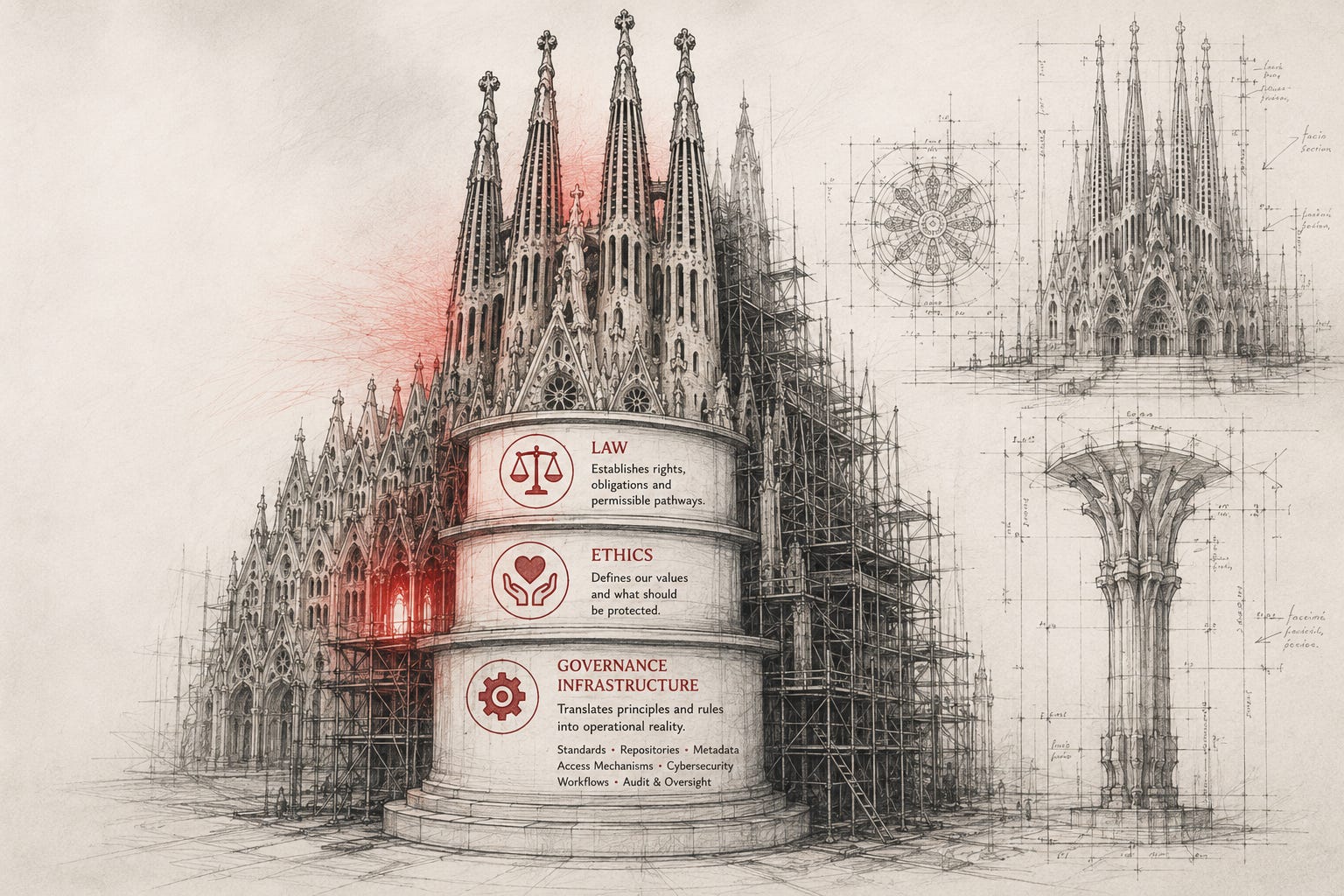
Watching these discussions unfold reminded me unexpectedly of Gaudí’s masterpiece. The Sagrada Família does not stand because of beautiful ideas alone. It stands because those ideas have been translated into structure. Hidden behind the breathtaking architecture are carefully engineered foundations, columns, vaults, and load-bearing systems that quietly make the entire vision possible. Without them, the cathedral would remain nothing more than an architect’s dream on paper.
By the end of OHBM, I realised neuroscience may be facing a remarkably similar challenge.
For more than two decades, we have devoted enormous effort to developing ethical principles, privacy protections, consent models, neurorights, and legal frameworks for responsible neurodata sharing. These are indispensable foundations. They tell us what ought to be done and increasingly what is legally permissible.
Yet despite this remarkable progress, researchers around the world still struggle to share neurodata efficiently and responsibly in practice. That realisation led me to a question that has stayed with me ever since:
Perhaps neuroscience does not suffer from a shortage of ethics or law. Perhaps it suffers from a shortage of governance infrastructure.
When Ethics and Law Are Not Enough
One of the most important lessons I learned at OHBM was that neuroscience has already made remarkable progress in developing ethical principles and legal pathways for responsible data sharing. Yet many research groups continue to encounter practical obstacles even when they have participant consent, ethics approval, institutional support, and legal authority to share data.
The barriers are often surprisingly mundane.
Metadata standards do not align. Repositories require different formats. Institutions have incompatible governance procedures. Cloud-computing environments create new security requirements. Access committees operate differently. Data dictionaries cannot communicate. Computational workflows are difficult to reproduce.
The result is that researchers may have every ethical and legal reason to collaborate, yet still struggle to do so.
It made me realise that perhaps we have been asking only part of the question.
A Governance Ecosystem
At OHBM, I had the privilege of seeing first-hand how neuroscientists think about collaboration. What struck me most was that some of the most exciting conversations were not about individual discoveries but about building shared infrastructure: repositories, standards, interoperable workflows, computational platforms, and collaborative ecosystems that make large-scale neuroscience possible.
Through our own work on the BRIDGE Brain Data Governance Project, we have experienced exactly the same phenomenon. Time and again, we found that the law was rarely the primary obstacle. Most jurisdictions already provide lawful pathways for responsible neurodata sharing.
Similarly, ethics provides the normative foundations that allow researchers to justify sharing in ways that respect participants, promote trust, and protect privacy.
The real challenge often lies somewhere in between.
This has led me to think about neurodata governance as an ecosystem composed of three interdependent layers.
-
At its foundation lies ethics, which articulates the values that should guide research, respect for persons, autonomy, justice, beneficence, and trust.
-
Built upon those values is law, which establishes rights, obligations, safeguards, and permissible pathways for data sharing.
-
But between these foundations and successful scientific collaboration lies a third layer that has received comparatively less attention: governance infrastructure.
This includes the standards, repositories, metadata frameworks, cybersecurity mechanisms, computational platforms, access procedures, audit systems, governance toolkits, interoperability frameworks, and operational processes that transform ethical aspirations and legal permissions into something researchers can actually use.
In other words:
Ethics tells us what should be valued.
Law tells us what is permissible.
Governance infrastructure determines what is operationally possible.
These layers are not alternatives to one another. They are complementary.
Just as a cathedral requires both architectural vision and structural engineering, responsible neuroscience requires both ethical principles and the practical infrastructures that enable them.
Aristotle Was Right
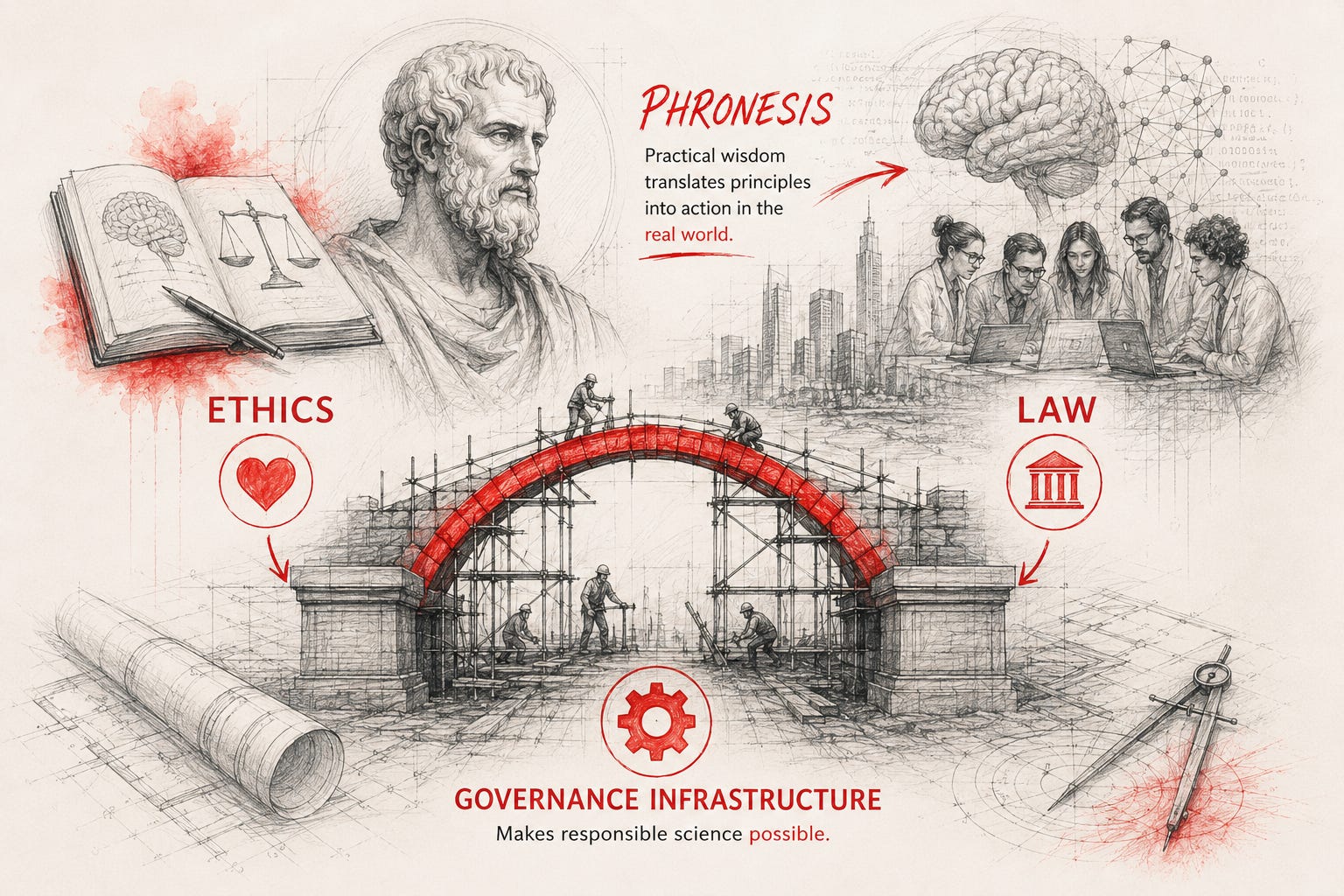
More than two thousand years ago, Aristotle distinguished between theoretical knowledge (epistēmē) and practical wisdom (phronesis).
Knowing what is good is not the same as knowing how to achieve it. Phronesis is the ability to translate principles into action within the complexities of the real world.
Perhaps that is precisely what neuroscience now needs.
We have developed sophisticated ethical frameworks. We have increasingly mature legal systems. Now we must invest equally in the practical wisdom of governance. Not governance as bureaucracy. Governance as enablement. Governance as the institutional craftsmanship that allows responsible science to flourish.
Lessons from Collaborative Innovation
Another lesson from OHBM was the extraordinary culture of collaboration that exists within neuroscience. Researchers openly discussed software, standards, computational pipelines, repositories, and reproducible workflows. Entire communities have emerged around building shared infrastructure that benefits everyone.
It made me wonder whether this collaborative spirit could also transform governance itself. What if governance tools were developed with the same openness as scientific software? What if governance became something that researchers actively build together rather than something imposed upon them?
Through projects such as brainlife.io, FAIR neurodata standards, BIDS, Nipoppy, Neurobagel, and the BRIDGE Legal Toolkit, I began to see glimpses of this future.
Perhaps governance should not be viewed as an administrative burden. Perhaps it is itself an innovation ecosystem.
Looking Ahead
As neuroscience enters an era of NeuroAI, federated analysis, digital brain twins, predictive models, and increasingly sophisticated computational representations of persons, our governance challenges will only become more complex.
The future question is no longer simply whether neurodata may be shared responsibly. It is whether we can build governance ecosystems capable of supporting responsible data-to-model ecosystems at global scale.
Like the hidden engineering inside a Gothic cathedral, good governance is rarely what people notice first. But it is often what makes everything else possible.
Perhaps the next great frontier in neuroscience is not only discovering how the brain works. It is discovering how we can build the governance infrastructures that allow neuroscience itself to work responsibly, collaboratively, and at the scale that the future demands.
Stay curious,
Marietjie
This reflection is inspired by my first experience attending the Organization for Human Brain Mapping (OHBM) conference in Bordeaux, France, EU in June 2026.