

TIMSHEL IN THE AGE OF ALGORITHMS
Some books entertain us. Others quietly rearrange the furniture in our minds. And then there are books like East of Eden, which seem to walk into the room, pull up a chair and demand an argument.
I finished John Steinbeck’s great, unruly family saga feeling exhilarated, unsettled and slightly bereft. I wanted to return immediately to the Salinas Valley, to Samuel Hamilton’s restless inventiveness, Lee’s wisdom, Adam’s blindness, Cal’s anguish and the terrible human temptation to divide the world into the good and the damned. Yet one idea followed me out of the novel more insistently than all the others: timshel. Thou mayest.
In another passage, Steinbeck declares the value of “the free, exploring mind” and warns that if its glory can be killed, we are lost. Read in 1952, this is a defence of individuality against conformity and systems of control. Read in 2026, it sounds like a warning about recommender systems, behavioural profiling, persuasive design, brain-computer interfaces and technologies that do not merely wait for our choices, but increasingly anticipate, arrange and influence them.
When the architecture of choice is engineered around us, what does “thou mayest” still mean?
TIMSHEL: NEITHER DESTINY NOR INNOCENCE
The moral architecture of East of Eden is built on the story of Cain and Abel. Across generations, Steinbeck’s characters fear that cruelty is inherited, that guilt is a mark, and that a person born with darkness inside them can do little more than act it out. Cal feels this acutely. If his mother is monstrous, must he be monstrous too? If his family repeats an ancient pattern, is he merely the next line in the script?
Lee’s interpretation of timshel breaks the script. It is not a promise that human beings will conquer evil. It is not an order that they must. It is the possibility that they may. That small opening is the novel’s moral revolution. A person is shaped by ancestry, trauma, desire, resentment and circumstance, but is not reducible to them. Choice creates responsibility, it also makes redemption imaginable.

There is a delicious scholarly complication here. Steinbeck’s rendering of the Hebrew in Genesis 4:7 is linguistically disputed, the original word and its grammar do not map as neatly onto his famous formulation as Lee suggests. But the literary power survives the philological argument. Steinbeck is not offering a Hebrew lesson so much as an ethics of human possibility.
THE MODERN PROBLEM IS NOT INFLUENCE. IT IS ENGINEERED INFLUENCE.
No human decision emerges from a vacuum. Families shape us. Languages give us categories. Cultures supply stories about what is admirable, shameful, normal or possible. Friends persuade us, teachers guide us, advertisements tempt us. A completely unconditioned choice is neither realistic nor particularly human.
The difficult question is therefore not whether we are influenced. It is when influence becomes so hidden, asymmetrical, personalised and persistent that it begins to hollow out the agency on which meaningful consent and moral responsibility depend.
Persuasion addresses me as a person who can consider reasons. A nudge changes the environment in which I decide: the healthy meal is placed at eye level, organ donation becomes the default, a notification arrives at precisely the moment I am most likely to respond. Manipulation goes further. It conceals its purpose, exploits a vulnerability, distorts the available information or makes one path frictionless while exhausting anyone who tries to choose differently.
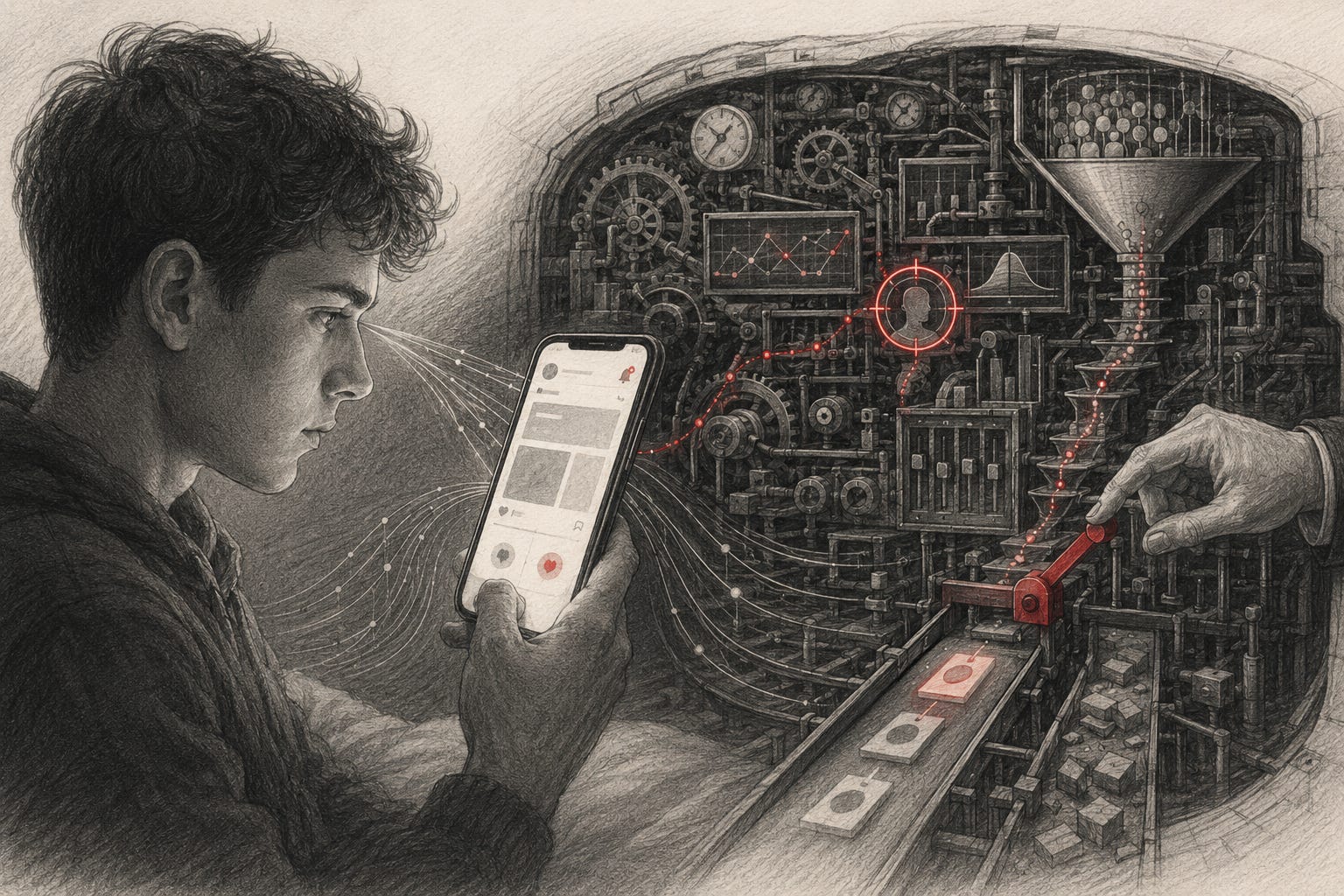
The difference is not always tidy. A reminder to take medication can support autonomy. An interface designed to keep an anxious teenager scrolling at 2 am does not. The same behavioural insight can help someone act on their values or help a platform act on them.
THE FEED AT THE DOOR
Social media platforms do not need to implant a thought to influence a life. They can rank what we see, repeat what provokes us, time rewards, test interface variations and learn which emotional cues keep each of us engaged. None of this turns users into puppets. That would be too simple. The more troubling reality is that people remain agents while making choices inside environments that other actors continuously optimise for goals the user did not choose.
This is why so-called dark patterns matter. The US Federal Trade Commission describes designs that can trick people into purchases, obstruct cancellation or steer them into surrendering data. The European Union’s Digital Services Act prohibits deceptive interface tactics on online platforms, while the EU AI Act prohibits certain subliminal, manipulative or deceptive AI practices that materially impair informed decision-making and are likely to cause significant harm.
These are important moves, but they also expose the legal difficulty. Must manipulation cause demonstrable “significant harm” before law intervenes? What about the slow erosion of attention, self-authorship or the ability to form a preference away from constant commercial observation? If a thousand individually trivial design choices cumulatively alter the person who is choosing, where does the injury begin?
WHEN TECHNOLOGY CROSSES THE SKULL
Neurotechnology raises the stakes because it can operate closer to the biological processes through which perception, emotion, movement and decision-making occur. Its promise is extraordinary: restoring communication, treating illness, supporting rehabilitation and returning forms of independence that disease or injury has taken away. A serious ethics of neurotechnology must begin by acknowledging those benefits, not by turning every electrode into a dystopian prop.
Yet the same ecosystem may collect neural signals, infer mental states, adapt interventions in real time or stimulate neural activity. Once artificial intelligence is added, the system can become both observer and actor, learning from the brain while modifying the conditions under which that brain responds.
The UNESCO Recommendation on the Ethics of Neurotechnology, adopted in November 2025 as the first global normative standard in the field, expressly identifies risks to autonomy, agency, mental privacy, personal identity and freedom of thought, alongside addiction and manipulation. Significantly, it recognises not only neural data, but also non-neural data capable of supporting inferences about mental states. The ethical boundary of the mind cannot sensibly depend on whether the signal came directly from an electrode or indirectly from a sufficiently revealing pattern of clicks, pauses, movements and searches.
The law is good at asking whether a person clicked “I agree”. It is less practised at asking who designed the chooser.
THE WORLD IS BEGINNING TO ANSWER — BUT IN FRAGMENTS
The legal vocabulary does not begin with neurotechnology. The International Covenant on Civil and Political Rights protects privacy, freedom of thought, opinion and expression; the International Covenant on Economic, Social and Cultural Rights recognises the right to enjoy the benefits of scientific progress. The Convention on the Rights of Persons with Disabilities adds a vital insistence on dignity, individual autonomy, privacy and equal participation, while the Convention on the Rights of the Child reminds us that developing minds require particular protection.
Read together, these instruments do not yet create a neat, freestanding right to mental self-determination. They do, however, reject the idea that the mind is simply another market, dataset or technical surface open to optimisation.
Newer instruments bring those older rights into the neurotechnology age. The OECD Recommendation on Responsible Innovation in Neurotechnology, adopted in 2019, sets out principles for responsible innovation, safety, inclusivity, protection of personal brain data and public deliberation. In April 2025, the UN Human Rights Council adopted Resolution 58/6 on neurotechnology and human rights. UNESCO’s 2025 Recommendation then supplied the first global normative framework devoted specifically to the ethics of neurotechnology.
These instruments are not legally binding in the same way as treaties, but they matter: they establish a shared language, orient national law and make it harder for public and private actors to pretend that agency, mental privacy and identity are merely optional design preferences.
Regional and national experiments show both momentum and fragmentation. The Inter-American Juridical Committee’s 2023 Declaration places identity, autonomy and the privacy of neural activity at the centre of a regional human-rights approach. The Council of Europe is asking whether existing protections for privacy, freedom, autonomy, integrity and non-discrimination are sufficient, or whether cognitive liberty, mental privacy and psychological continuity need clearer recognition.
The European Union addresses parts of the problem through data protection, consumer law, the Digital Services Act and the AI Act. Chile went further in 2021 by amending its Constitution to require special protection for brain activity and the information derived from it. South Africa, like many constitutional democracies, can draw on dignity, privacy and bodily and psychological integrity without yet having a dedicated neurorights provision.
But fragments are not yet a coherent international law of the free mind. Human-rights law asks whether dignity, privacy, freedom of thought and related interests have been respected. Data-protection law asks whether information was lawfully processed. Consumer law looks for deception or unfairness. Medical law prioritises informed consent.
A platform, employer, or device maker may operate across borders, collect behavioural data with nominal consent, infer vulnerability in one jurisdiction and exploit it through systems designed in another. No single legal box captures the whole injury. The chooser is altered, yet each actor can insist that its own narrow obligation was satisfied.
The international task is therefore not simply to export one region’s solution. It is to build a minimum global floor while leaving room for cultural and constitutional difference: protection against covert mental interference, special safeguards for children and people in dependent relationships, strict governance of neural data and mental-state inferences, meaningful remedies; and equitable access to beneficial technologies.
This matters acutely in the Global South, where exclusion, dependency, weak regulatory capacity and unequal access can make a formal opt-out meaningless. Timshel cannot be reserved for those wealthy enough to refuse.
CONSENT IS NOT ENOUGH IF THE CHOOSER IS BEING ENGINEERED
Bioethics has long treated informed consent as an expression of autonomy. The familiar requirements are disclosure, understanding, capacity and voluntariness. Digital systems test each of them. Meaningful disclosure is difficult when an intervention changes dynamically. Understanding is fragile when even developers cannot fully explain an inference. Voluntariness becomes ambiguous when refusal means exclusion from work, education, healthcare or social participation.
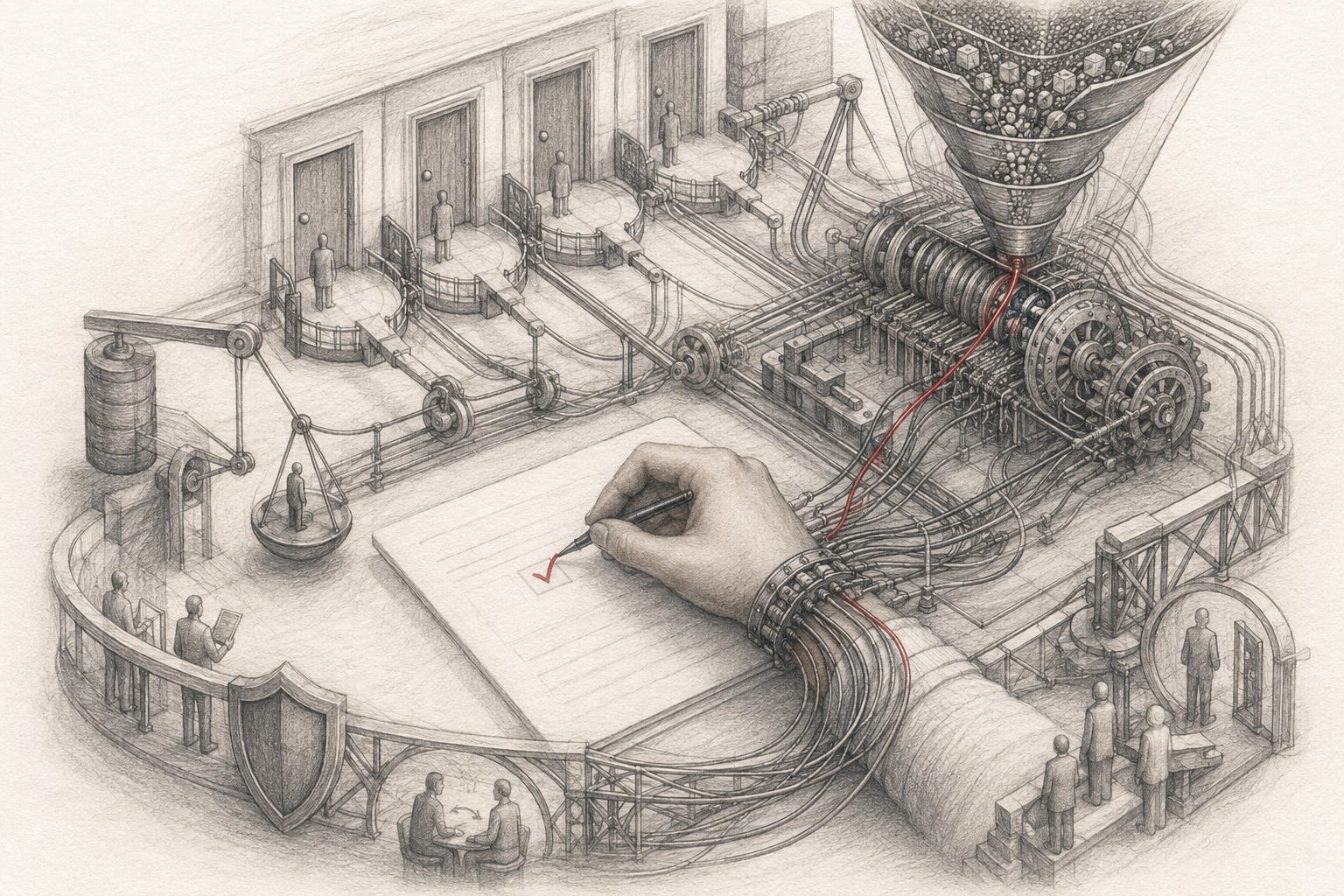
A signature or button press may therefore be procedurally valid and ethically hollow. We should stop treating consent as a magical solvent that dissolves every power imbalance it touches. Consent remains essential, but it needs institutional allies: purpose limitation, strict protection for mental inferences, duties against exploitative design, meaningful alternatives, ongoing withdrawal, independent oversight, cybersecurity, auditability, cross-border regulatory cooperation and routes to challenge decisions or interventions.
This is the difference between declaring a right and governing for it. Rights name what matters. Governance makes that protection real through design standards, professional duties, procurement rules, regulators, technical testing and consequences when systems cross the line.
STEINBECK WAS WRONG ABOUT COLLABORATION — AND RIGHT ABOUT RESPONSIBILITY
I cannot follow Steinbeck all the way when he insists that nothing is created by two people and that groups merely extend the miracle produced by a solitary mind. Science is collaborative. Music is relational. Languages, methods and traditions make individual creativity possible. Even this novel grew from scripture, family history, editorial exchange and the cultural world around its author. In the age of generative AI, the romantic image of a completely solitary creator becomes harder still to defend.
But his provocation contains a truth worth keeping. Institutions are often very good at distributing responsibility until nobody appears responsible at all. “The algorithm” recommended it. “The data” revealed it. “The market” demanded it. “The user” consented.
Collaboration can create, bureaucracy can build, artificial intelligence can generate. None of this releases the human beings and institutions behind a system from the duty to decide what ought to be built, whose interests it serves and which parts of personhood must remain beyond optimisation.
A RIGHT TO TIMSHEL?
Do we need a new internationally recognised neuroright to cognitive liberty or mental self-determination? Perhaps. But we should be careful not to mistake the naming of a right for its protection. The more immediate task is to interpret and connect the rights we already have across legal systems, while developing enforceable rules for technologies that infer, predict or intervene in mental life.
Across legal systems, a commitment to timshel would not promise a mind untouched by culture, persuasion or technology. It would protect a person’s practical ability to reflect, refuse, revise and choose without covert exploitation. It would ask designers to build for agency rather than mere engagement; require special protection where children or vulnerable users are concerned, distinguish therapeutic support from commercial capture, and treat mental-state inferences as sensitive even when no brain scanner produced them.
Above all, it would place the burden on powerful actors to show that systems affecting the mind are compatible with human dignity, equality and democratic freedom.
Steinbeck’s great word does not absolve Cal. It gives him a future that is not identical to his past. That is why it still matters. The technologies surrounding us increasingly claim to know what we will click, buy, fear, believe and become. Some will help us act more freely. Others will quietly narrow the corridor and call the remaining path a choice.
The question for law is not whether human beings possess a perfectly pure, metaphysically uncaused free will. Law has never needed that impossible creature. The question is whether we are preserving the social, technical and psychological conditions in which a person can still encounter more than one meaningful future.
The future of human freedom may depend on leaving room for “may”.
Stay curious,
Marietjie