
The Right to Remain Mysterious
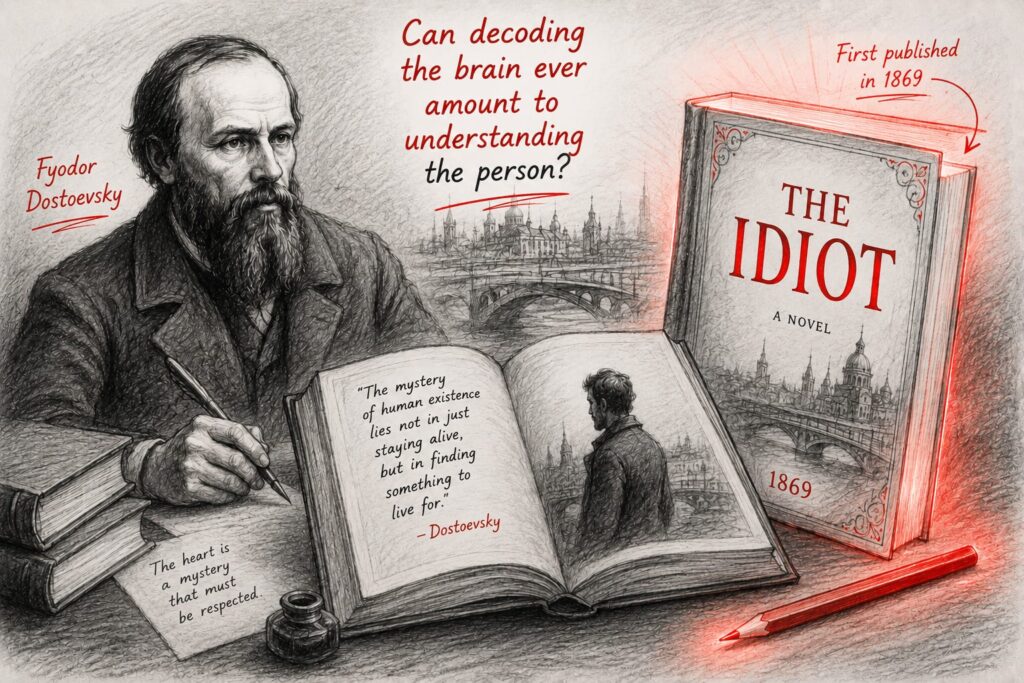
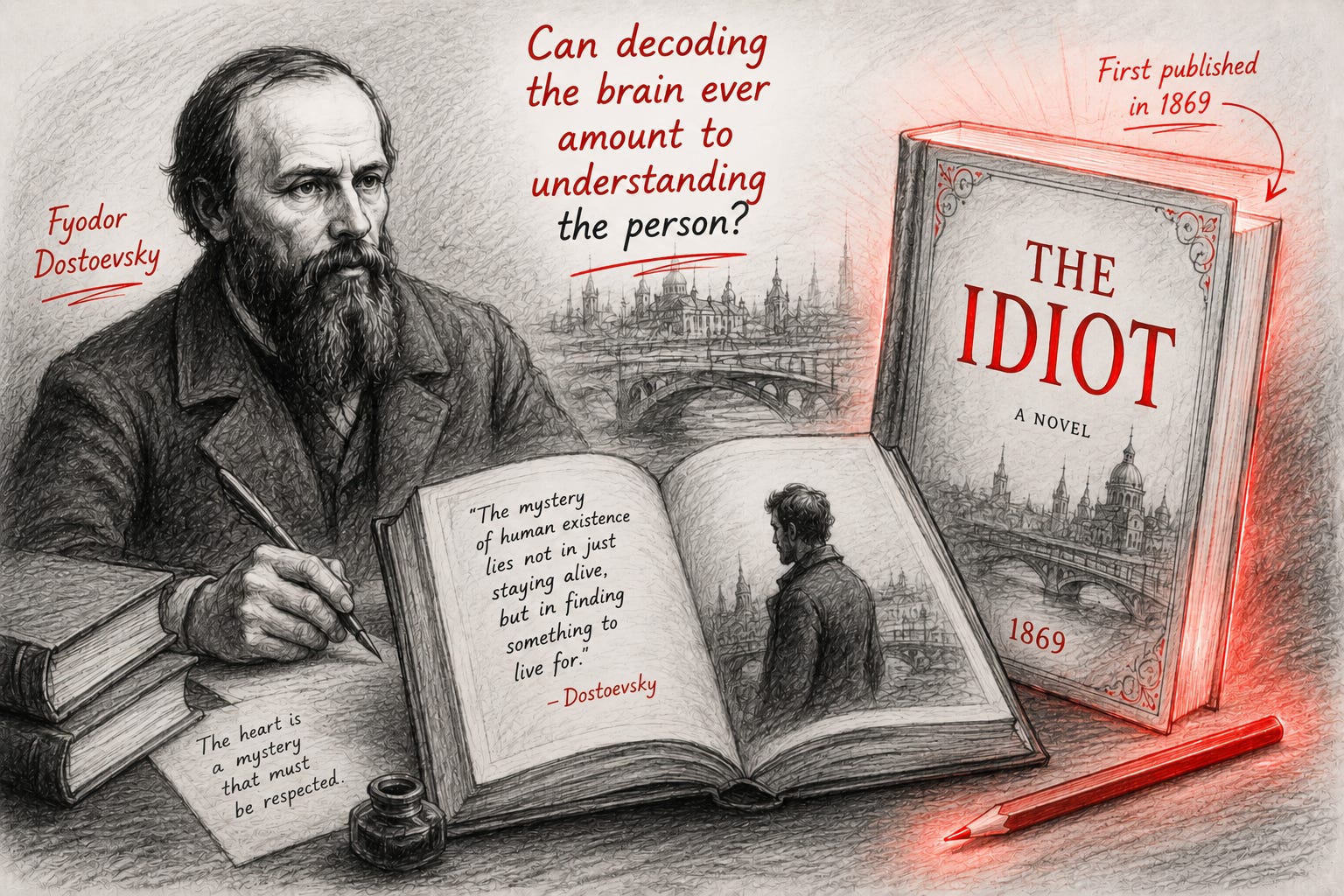
There are books that entertain us, others that educate us, and a rare few that quietly change the way we see the world. I recently experienced the latter while reading Fyodor Dostoevsky’s The Idiot. Although first published in 1869, I repeatedly found myself reflecting on its unexpected relevance to twenty-first-century debates about neuroscience, artificial intelligence and mental privacy.
Dostoevsky wrote almost 160 years before brain-computer interfaces, predictive algorithms and modern neuroimaging. Yet his novel appears to anticipate one of the most important questions now confronting neuroscientists, ethicists and policymakers: Can decoding the brain ever amount to understanding the person?
Perhaps the greatest danger posed by contemporary neuroscience and artificial intelligence is not that these technologies will one day read our minds perfectly. It is that society may begin treating their necessarily partial interpretations as complete knowledge of who we are.
This is no longer merely a philosophical concern. In November 2025, UNESCO adopted the Recommendation on the Ethics of Neurotechnology, the first global normative instrument specifically devoted to the governance of neurotechnology. It recognises both the therapeutic promise of these technologies and their potential implications for mental privacy, autonomy, identity, freedom of thought and human dignity.
Significantly, the Recommendation is concerned not only with information obtained directly from the brain, but also with the sensitive conclusions that may be drawn from neural, biometric, behavioural and other data. The ethical challenge is therefore not simply what technology can observe about the brain, but what it claims to know about the mind.
A novel about misunderstanding
At the centre of The Idiot is Prince Lev Nikolayevich Myshkin, who returns to Russia after spending several years receiving treatment for epilepsy in Switzerland. He enters a society preoccupied with status, money, romantic rivalry and appearance, bringing with him an unusual openness and compassion that the people around him struggle to comprehend.
Almost immediately, they begin trying to explain him. Some see innocence, while others see stupidity. Some regard his openness as weakness, while others suspect manipulation. His behaviour is attributed to illness, immaturity, naïveté or moral eccentricity. After only a few encounters, those around him become convinced that they know what kind of person he is and how he will behave.
Dostoevsky gradually exposes the inadequacy of these judgements. The characters are not always entirely wrong about Myshkin. Many notice genuine aspects of his personality. Their mistake lies in believing that partial insight amounts to complete understanding.
The more confidently they claim to know him, the clearer it becomes that something essential continues to escape them.
![Holbein's painting from The Idiot (Painting in Ganya's house) [Info below] : r/dostoevsky](https://substackcdn.com/image/fetch/%24s_!fcuA!,f_auto,q_auto:good,fl_progressive:steep/https%3A%2F%2Fsubstack-post-media.s3.amazonaws.com%2Fpublic%2Fimages%2F0200fba4-8671-4002-981f-5886438edcc1_1080x494.jpeg "Holbein's painting from The Idiot (Painting in Ganya's house) [Info below] : r/dostoevsky")
As I reflected on these encounters, I realised that Dostoevsky’s characters behave in a surprisingly familiar way. They collect observations, identify patterns, classify behaviour and construct increasingly elaborate explanations. In that sense, they resemble today’s predictive systems. The tragedy is not that every inference is false. It is that the inference is mistaken for the whole person.
The expanding ambition to decode the brain
We often imagine neurotechnology through its most dramatic forms, implanted electrodes, robotic limbs controlled by thought, or computers translating neural activity into speech. These developments are no longer speculative.
The Neuralink PRIME Study, for example, is evaluating a wireless, surgically implanted brain-computer interface in people with severe paralysis. Synchron’s SWITCH clinical study is similarly examining whether an implanted interface can allow users to control digital devices through neural signals.
These projects represent extraordinary scientific achievements. For someone who has lost the ability to move or speak, translating intended movement or attempted speech into computer commands may restore communication, agency and independence.
Yet these advances are occurring alongside increasingly sophisticated forms of artificial intelligence. Algorithms can process neural and behavioural data, detect patterns invisible to human observers and generate predictions about movement, attention, language, mood or cognition.
Nor must a system necessarily access the brain directly. Voice patterns, facial movements, eye tracking, typing behaviour, wearable-device data and online activity may all be used to generate inferences about emotional condition, cognitive vulnerability or likely behaviour.
This is why the distinction between neural data and mental-state inference has become so important.
From brain data to mental-state inference
Traditional privacy law generally focuses on the collection and processing of information. In neurotechnology, this has encouraged an understandable emphasis on protecting neural data obtained through electroencephalography, implanted electrodes, neuroimaging or other means.
But the deeper ethical problem often emerges after the data are collected. A recording of neural activity is not itself a thought, intention, memory or emotion. It becomes meaningful only through interpretation, when researchers or algorithms connect patterns in the data to conclusions about what someone thinks, feels or intends.
A recent ethico-legal analysis of mental-state inferences drawn from brain data highlights precisely this problem. The authors examine the chain of reasoning between measured neural activity and conclusions about a person’s mental state, warning that privacy may be threatened not only by accurate inferences, but also when uncertain or inaccurate conclusions are treated as reliable.
This distinction is crucial. The harm does not require a machine to read someone’s mind correctly. A person may be disadvantaged because an employer, insurer, court, clinician or public authority wrongly believes that an algorithm has revealed something definitive about that person’s mental state.
The ethical issue therefore extends beyond protecting the original data. It also concerns the classifications, predictions and judgements generated from them.
When prediction is mistaken for understanding
Modern neuroscience is remarkably skilled at identifying correlations between measurable biological activity and aspects of cognition or behaviour. Artificial intelligence strengthens this capacity by recognising complex patterns across large datasets.
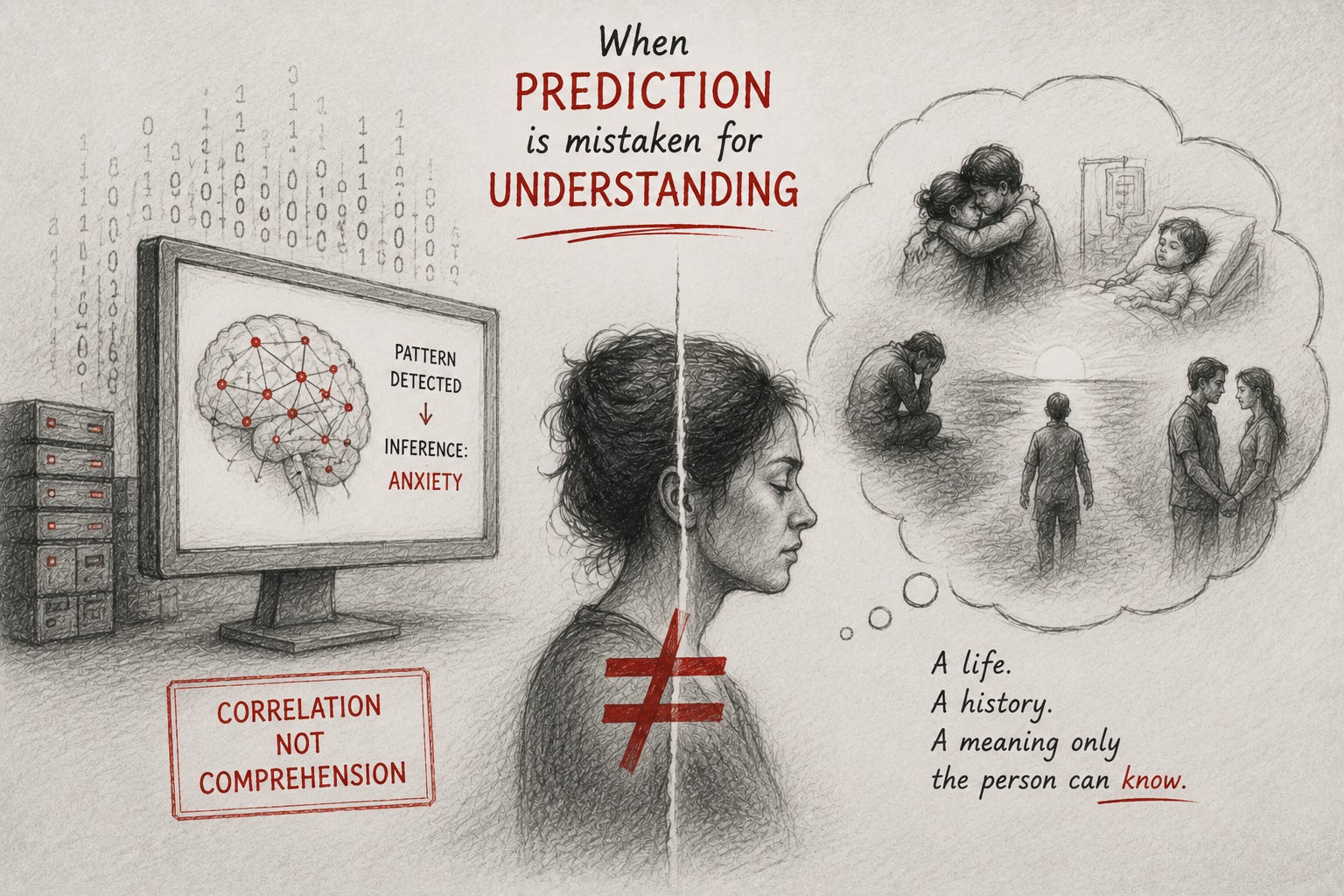
These correlations may be clinically valuable. They may assist diagnosis, restore lost functions or enable earlier intervention. Yet correlation, however sophisticated, is not comprehension.
A neural signature associated with grief cannot explain what has been lost. A pattern associated with fear cannot tell us whether that fear concerns physical danger, social rejection, the illness of a child or a remembered trauma. An algorithm may infer anxiety, but it cannot understand what courage means to the person experiencing it.
Similarly, neural activity associated with love cannot capture the history of a relationship. It cannot record the accumulation of shared experiences, disappointments, forgiveness, loyalty and hope through which that love acquired meaning.
Science may tell us increasingly more about what happens in the brain when people think, remember, decide or feel. That does not mean it can provide a complete account of what those experiences mean.
This distinction lies at the heart of The Idiot. Myshkin can be watched, categorised and partially explained, but his inner life cannot be exhausted by the interpretations imposed upon him.
The danger of epistemic overconfidence
The phrase epistemic overconfidence captures the central danger. It describes the belief that because a prediction is scientifically generated or statistically accurate, it necessarily amounts to genuine knowledge of the person concerned.
An algorithm may correctly identify an increased risk of depression or detect signs of cognitive fatigue. Yet such a conclusion remains an interpretation based on selected data, assumptions and thresholds. It does not tell us everything about the individual, determine how that person will act or explain how the experience fits within a particular life.
The consequences of forgetting these limits may be serious. Predictive conclusions can influence clinical care, employment, insurance, education and criminal justice. When such systems are treated as objective windows into the mind, the subject may struggle to challenge the conclusion. How does one contest an institution that claims its judgement comes not from prejudice or speculation, but from the person’s own brain?
Accuracy therefore cannot be the only ethical standard applied to predictive neuroscience. Even a reasonably accurate system may become unjust when its predictions are removed from context, used without meaningful consent or treated as definitive evidence of character, intention or future behaviour.
The issue is not only privacy. It is also power: who may generate mental-state inferences, who may act upon them and whether individuals can question, contextualise or reject those conclusions.
A right to remain mysterious?
This led me to wonder whether contemporary discussions about neurorights have overlooked something fundamental.
We rightly speak about mental privacy, cognitive liberty, mental integrity and freedom of thought. The OECD Neurotechnology Toolkit reflects these concerns, calling for safeguards against intrusive surveillance, non-consensual assessment and the manipulation of brain states or behaviour.
Yet perhaps these protections point towards an even deeper principle: a right to remain, at least in part, mysterious.
This would not be a right to deception or an argument against science. Rather, it would acknowledge that no collection of neural recordings, behavioural metrics or algorithmic predictions can legitimately be treated as an exhaustive account of a human being.
To remain mysterious does not mean that there is something shameful to hide. It means that every person possesses an inner life shaped by memory, relationships, culture, imagination, suffering and hope—dimensions of experience that cannot be reduced without remainder to measurable variables.
Such a right would protect more than secrecy. It would protect people against being reduced to profiles, probabilities or predicted futures. It would recognise a space between what can be inferred about a person and who that person is.
It might also require practical safeguards. Individuals should know when intimate inferences are being made about them, understand the basis of those conclusions and be able to challenge inaccurate or decontextualised interpretations. Institutions should communicate the uncertainty surrounding predictive systems rather than presenting probabilistic assessments as unquestionable truths.
Most importantly, governance frameworks should resist the assumption that greater technological legibility is always desirable. A society in which every emotion, hesitation, vulnerability and preference can be continuously interpreted may be highly informed, but it may not be free.
Protecting mystery itself
Responsible neurotechnology requires more than secure databases, consent forms and cybersecurity. It also requires epistemic humility, an acknowledgement of the limits of what neural and behavioural data can tell us about another person.
Ethical governance should insist on distinctions between data and interpretation, association and causation, risk and destiny, prediction and understanding.
It should also recognise that the meaning of a mental experience cannot always be separated from the person’s own account. A neural measurement may provide valuable evidence, but it should not automatically displace first-person testimony. The individual whose brain is being measured remains the subject of the experience, not merely the object from which data are extracted.
As governments, scientists and ethicists develop frameworks for neurotechnology, they will understandably focus on data governance, cybersecurity, informed consent, safety and algorithmic accountability. These issues are essential.
Yet The Idiot suggests that they may not be sufficient.
Before asking how accurately a technology can decode the brain, we may need to ask a more fundamental question: What does it actually mean to understand another human being?
Dostoevsky does not deny that Prince Myshkin can be observed, analysed or partially explained. He shows instead that something always escapes the categories imposed upon him.
Nearly 160 years later, artificial intelligence is becoming increasingly capable of predicting aspects of cognition and behaviour, while neurotechnology provides unprecedented access to the biological processes accompanying thought and action. These developments may transform medicine and restore capacities once believed permanently lost.
But their success should not lead us to confuse a clearer view of neural activity with a transparent view of the human person.
Perhaps the greatest ethical risk is not that a machine will understand us perfectly. It is that institutions will act as though it does.
Mental privacy may therefore be about more than safeguarding thoughts or securing neural data. It may also be about preserving our ability to surprise others, revise ourselves, resist the identities assigned to us and remain more than the sum of the predictions made about us.
Perhaps human dignity depends partly upon recognising one of the most profound truths Dostoevsky leaves us with – every person remains, in some essential way, beautifully and irreducibly mysterious.
Stay curious,
Marietjie