
The Human Is Part of the Treatment
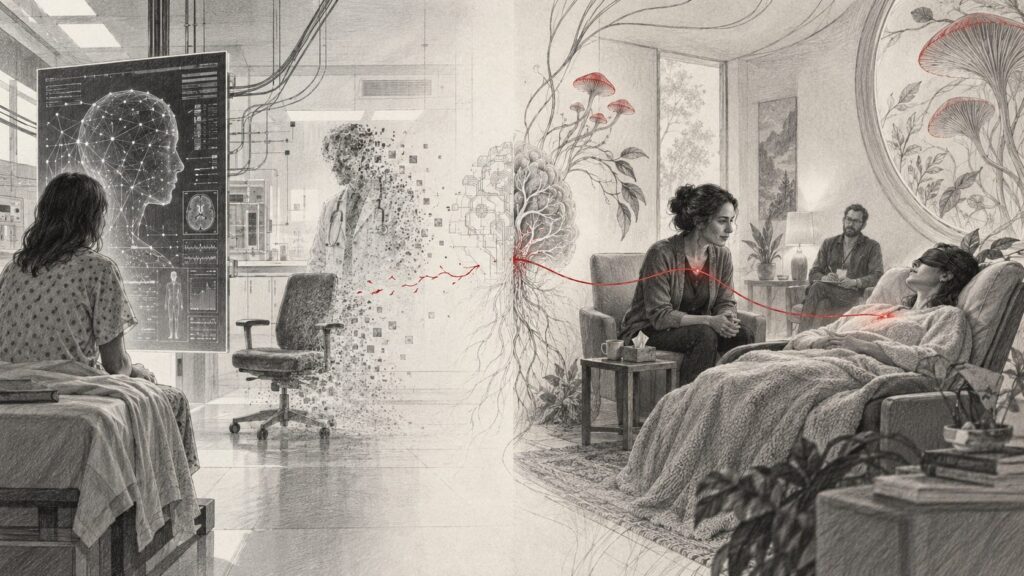
While listening to the FDA’s public hearing on the possible future therapeutic use of psychedelic drugs, I expected to hear mainly about molecules, dosage, purity, clinical endpoints and adverse events. Those questions were certainly present. But the conversation kept returning to a person. The person who prepares the patient, remains in the room while ordinary judgment is altered, recognises distress, chooses when to speak, decides when silence may be safer, and follows up after the intervention has run its course. The human being seemed to be moving from the margins of the protocol towards the centre of the treatment.
Important to note is that a public hearing is not a scientific verdict, and the comments made there should not be mistaken for FDA findings. Regardless, the structure of the hearing is revealing. The FDA expressly invited discussion about provider training and credentialling, patient safety, access, and data collection. These are not questions about the chemical composition of psilocybin. They are questions about the encounter surrounding it.
That struck me as deeply ironic. We are living through an age in which artificial intelligence is being offered as a substitute for more and more forms of human labour, including parts of healthcare. AI may screen symptoms, produce clinical notes, recommend interventions, and converse with patients who cannot find or afford a therapist. Yet, just as healthcare begins asking how much human involvement can be removed, psychedelic medicine may be forcing us to ask when human presence becomes indispensable.
A molecule does not enter the room alone
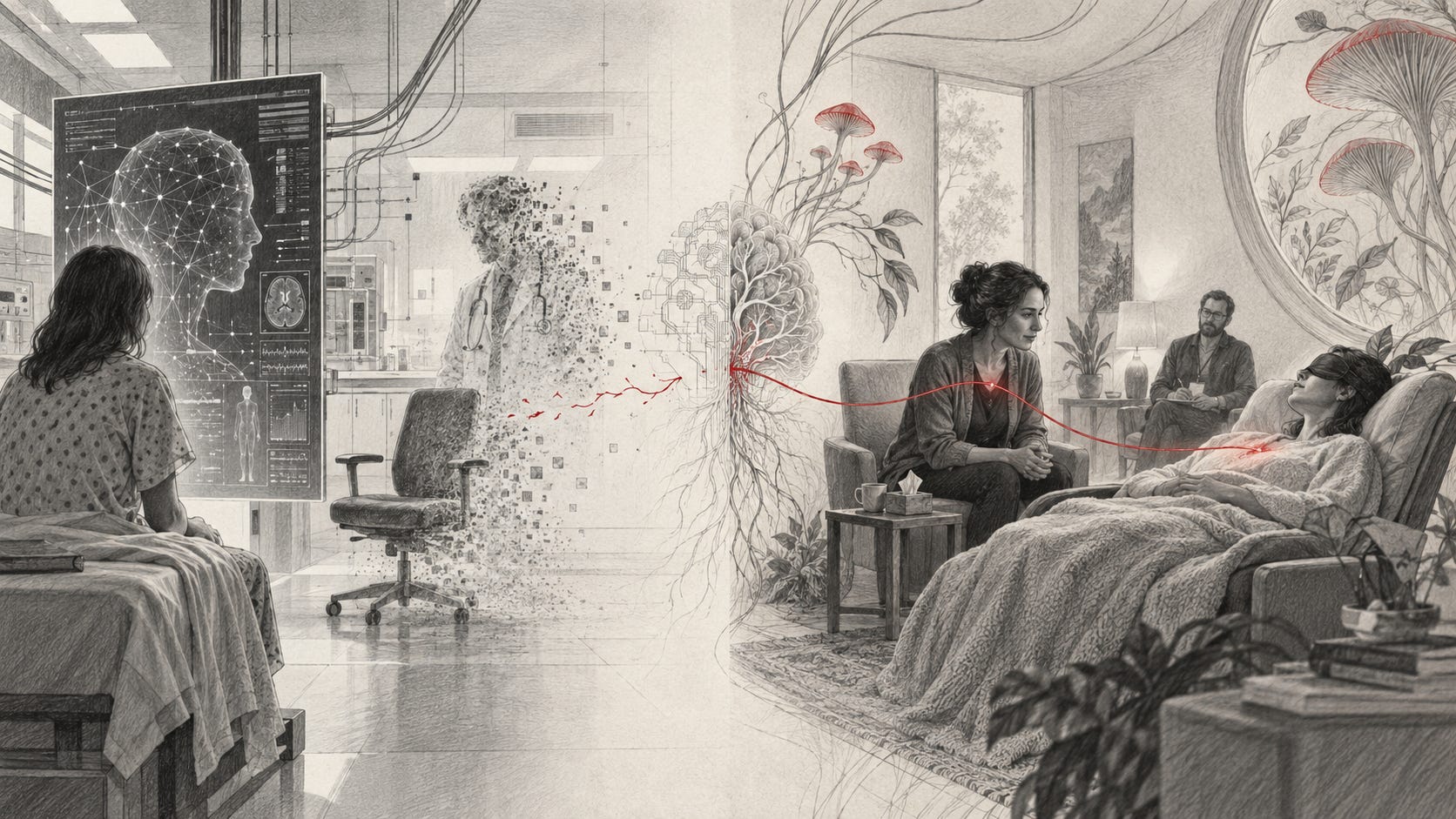
We are accustomed to thinking of medicines as products. A tablet contains an active ingredient; regulators assess its quality, safety, and efficacy; a clinician prescribes it; and the patient often takes it at home. The therapeutic action is attributed principally to the product. Psilocybin unsettles this familiar picture. The drug may alter perception, cognition, and judgment for many hours. The person taking it may become unusually vulnerable to the emotional atmosphere, the expectations created beforehand and the conduct of the person sitting beside them.
The FDA’s July 2026 final guidance on psychedelic clinical investigations takes this seriously. It recommends two monitors throughout a treatment session, with a licensed, graduate-level psychotherapy professional serving as the lead monitor. It also says informed consent should explain that changes in cognition and judgment may persist for hours and may be accompanied by increased vulnerability and suggestibility. This does not establish that a caring relationship is the pharmacological equivalent of psilocybin. It establishes something more immediate, the human being in the room is part of the intervention’s safety architecture. Their competence, restraint, and judgment can no longer be dismissed as background conditions.
Care, confounder, or active ingredient?
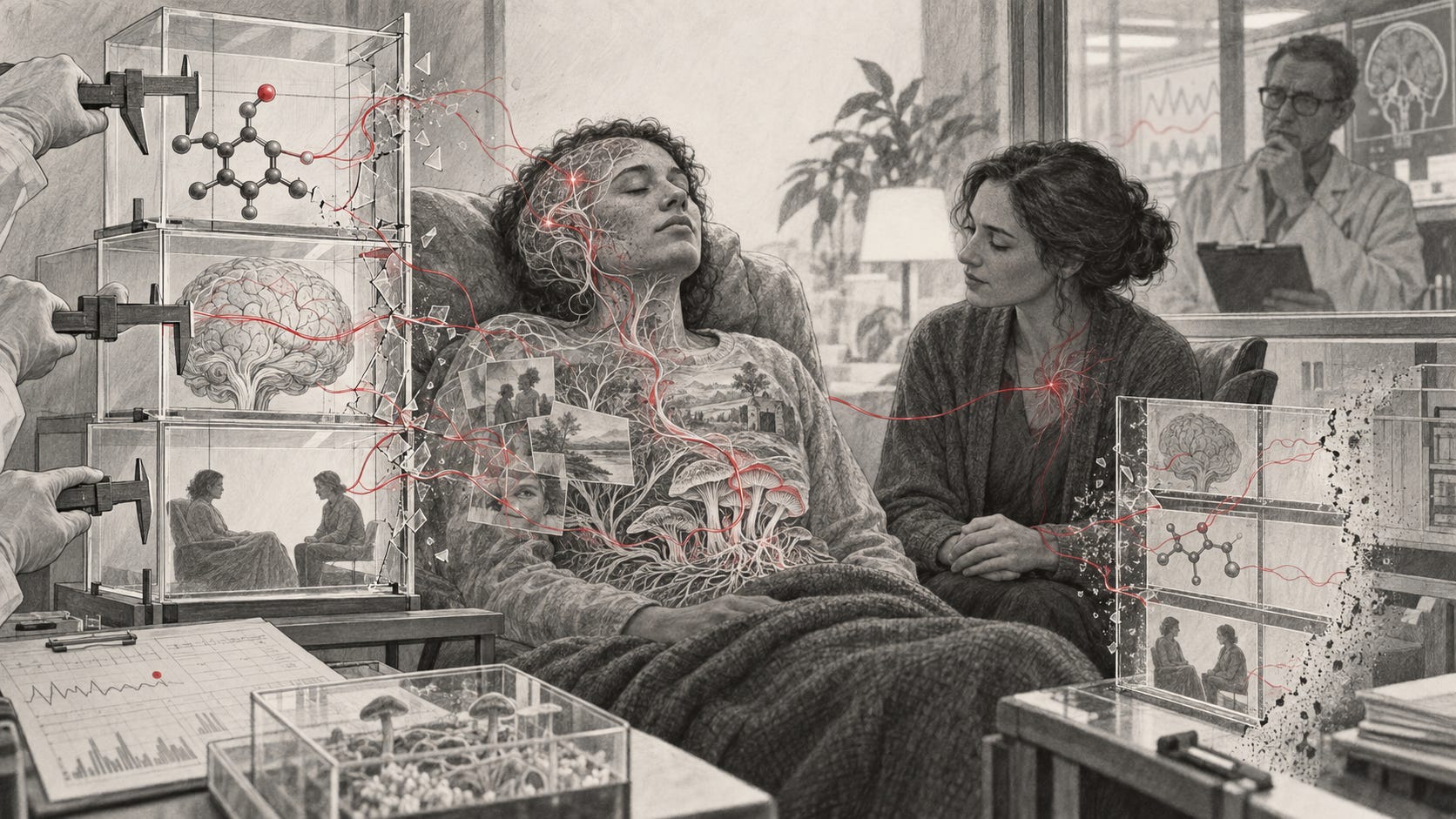
Here the science becomes genuinely fascinating. Drug regulation asks researchers to isolate the effect of a molecule from placebo effects, expectations, biased observation and other influences. Psychedelic trials make this unusually difficult. Participants and monitors can often tell who received the active drug. The therapeutic encounter may also influence what the participant expects, how the experience is interpreted, and what is remembered afterwards. The FDA therefore describes psychological support or psychotherapy as an additional variable that complicates the assessment of efficacy and any future product label. It says plainly that psychotherapy’s contribution to observed benefit has not yet been characterised.
The emerging research offers signals, but not a simple answer. A small 2024 trial analysis involving 24 participants found that a stronger therapeutic alliance before dosing was associated with better subsequent depression scores and more intense experiences of psychological insight. An earlier analysis of 30 participants also found relationships between therapeutic alliance, the acute psychedelic experience, and depression outcomes. However, a larger 2026 post-hoc analysis involving 79 participants reached a more qualified conclusion. The alliance appeared to facilitate aspects of the psychedelic experience, but its direct effect on therapeutic efficacy was limited or absent. The authors also disclosed substantial industry relationships, which does not invalidate the study but belongs in any careful reading of it.
The honest conclusion is therefore not that the therapist has been proven to be “as important as the drug”. We do not yet know that. The more defensible conclusion is that the molecule, the participant’s experience, and the human relationship interact in ways our conventional product-centred regulatory model struggles to separate. In a laboratory, the human relationship may look like a confounding variable. In care, it may be part of the mechanism.
The human is also the risk
It would be tempting to turn this into a sentimental defence of human connection. That would miss the more difficult biolegal point.
The same person who provides reassurance also occupies a position of unusual authority. Their words may shape the meaning a participant gives to a frightening image, a childhood memory, or a sudden conviction. Touch may feel grounding to one person and intrusive to another. A participant may disclose trauma, sexuality, family conflict, or an allegation of abuse while judgment is altered. The facilitator may become the interpreter of an experience that feels more real or significant than ordinary consciousness. Human presence can protect but it can also persuade, direct, exploit, or harm.
This is why consent cannot be treated merely as a form signed before the door closes. It must govern the powers that arise after the drug takes effect, inlcuding who may touch the participant, what language may be used, whether a session may be recorded, how distress is managed, when medical help is called, and what may later be done with the participant’s disclosures.
Oregon’s regulated psilocybin-services system offers an instructive early example. Its official facilitator guidance and consent materials provide separate permissions for supportive touch, the presence of other people, and audio or video recording. Its scope-of-practice guidance addresses conflicts of interest, confidentiality, nondirective conduct, and the participant’s right to withdraw consent for sensory interventions. These rules recognise the important principle that human supervision must itself be supervised. Warmth, empathy, and good intentions are not substitutes for enforceable boundaries.
AI knocking at the door
Where, then, does artificial intelligence belong? It would be unrealistic, and perhaps undesirable, to exclude it completely. AI tools may help identify contraindications, schedule follow-up, detect patterns in adverse-event data, support translation, or alert a clinician to physiological changes. Used carefully, they may extend scarce expertise and reduce some costs. But there is a difference between assisting the person in the room and replacing them.
A conversational system might appear endlessly patient and non-judgmental. During a psychedelic experience, however, its apparent neutrality could be dangerously deceptive. Personalisation can become persuasion. Adaptive language can become suggestion. Continuous monitoring can become intimate surveillance. A system designed to maintain engagement may not know when the most therapeutic response is silence, or when the ethical response is to summon a responsible human being.
The World Health Organization recently expressed a useful principle in a different health-policy context: AI should augment, not automate. I would borrow that principle for psychedelic care, but make it more concrete. AI should not be the sole monitor of a person whose judgment has been pharmacologically altered. It should not seek new, high-stakes consent during intoxication. It should not deliver commercial recommendations, behavioural nudges, or advertising during that period of vulnerability. There should always be a human professional capable of intervening and answerable for the treatment.
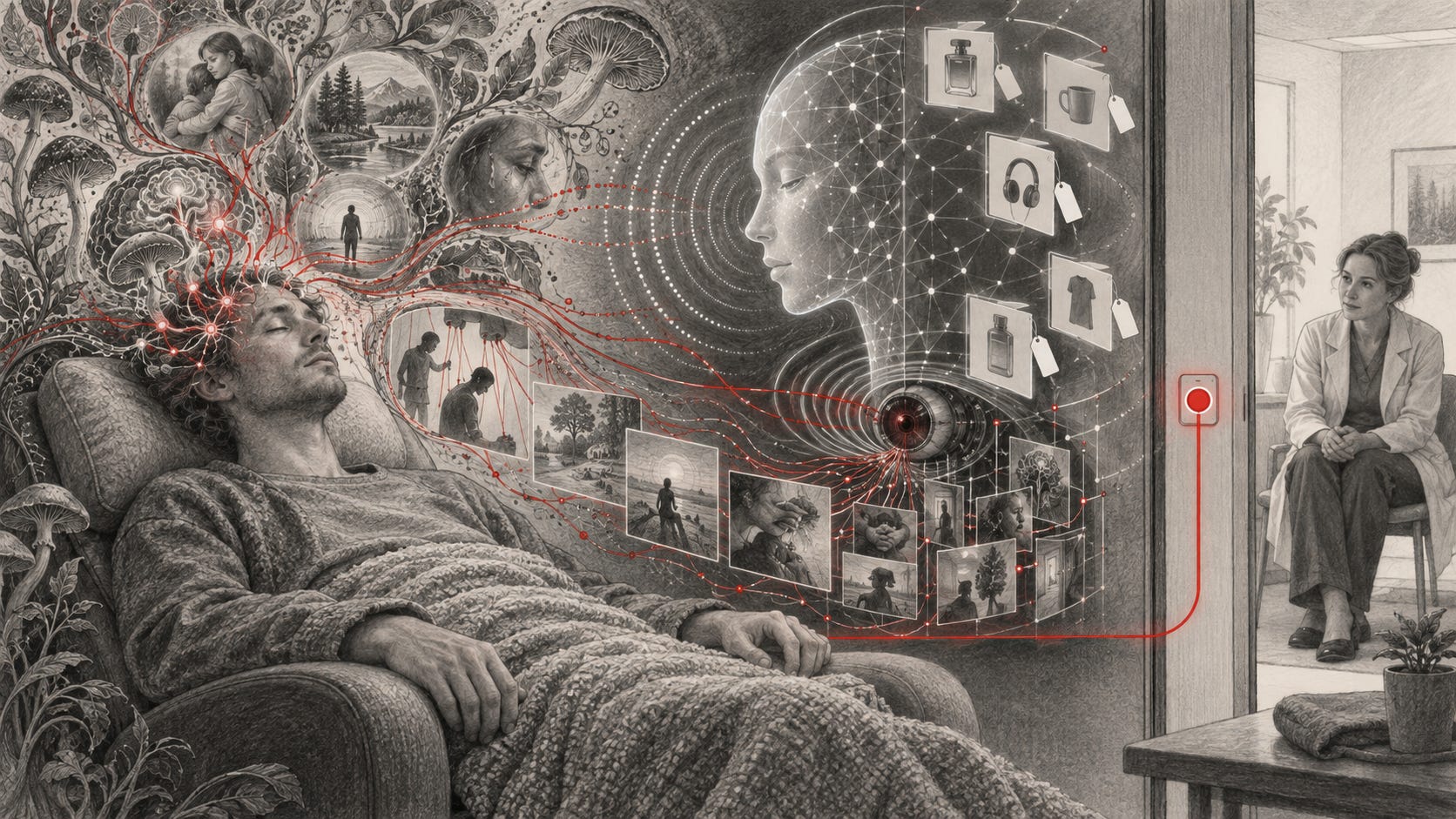
In addition, any AI-generated record or inference should fall within strict rules governing access, retention, secondary use, and deletion of health data. This matters because a psychedelic session may generate extraordinarily intimate data. In the United States, health-privacy law does not apply merely because an interaction feels therapeutic: HIPAA principally regulates covered entities and their business associates. A wellness platform, facilitator, or technology provider may sit outside parts of that framework.
Regulating the relationship
The deeper difficulty is that American law divides the intervention into pieces. The FDA regulates the investigational drug and may eventually regulate an approved product through its label, post-market requirements, or a risk-management programme. States regulate professional licensing, facilities, malpractice, and emerging service models. Privacy law depends on who collects the information and in what capacity. Insurers may determine whether the hours of necessary human supervision are practically accessible or merely theoretically available. Each institution sees a slice. The participant experiences the whole.
This is why I think the proper regulatory unit is the combined intervention: product, person, place, process, information, and remedy. We need standards not only for what is swallowed, but for who is present; not only for initial consent, but for the continuing boundaries of the encounter; not only for acute physiological events, but for manipulation, boundary violations and longer-term psychological harm; and not only for collecting session data, but for preventing those data from becoming training material for commercial systems.
When something goes wrong, the participant should not have to discover that every actor governed only one fragment of the experience while no one was responsible for the whole.
What psilocybin may teach the age of AI
Perhaps psilocybin will not prove to be “the last unautomatable medicine”. That phrase is too romantic, and technology has a habit of making fools of confident predictions. But psychedelic care exposes something our enthusiasm for automation often conceals. A relationship is itself a kind of technology: powerful, variable, difficult to standardise, and capable of producing both benefit and harm. We have developed sophisticated systems for inspecting chemicals and are rapidly developing systems for auditing algorithms. We remain less comfortable regulating the quieter power exercised by one person over another in a room.
The answer is not to idealise the human or demonise the machine. It is to decide which forms of care require presence, which tasks may safely be delegated, and which powers should never be exercised over a person whose capacity to resist influence has temporarily changed. When a molecule alters the mind, the person, or system, speaking into that altered state enters the causal and ethical chain. The human is not background noise. Nor are they automatically the cure. They are part of the treatment, and the law should finally learn to see them that way.
Stay curious,
Marietjie