
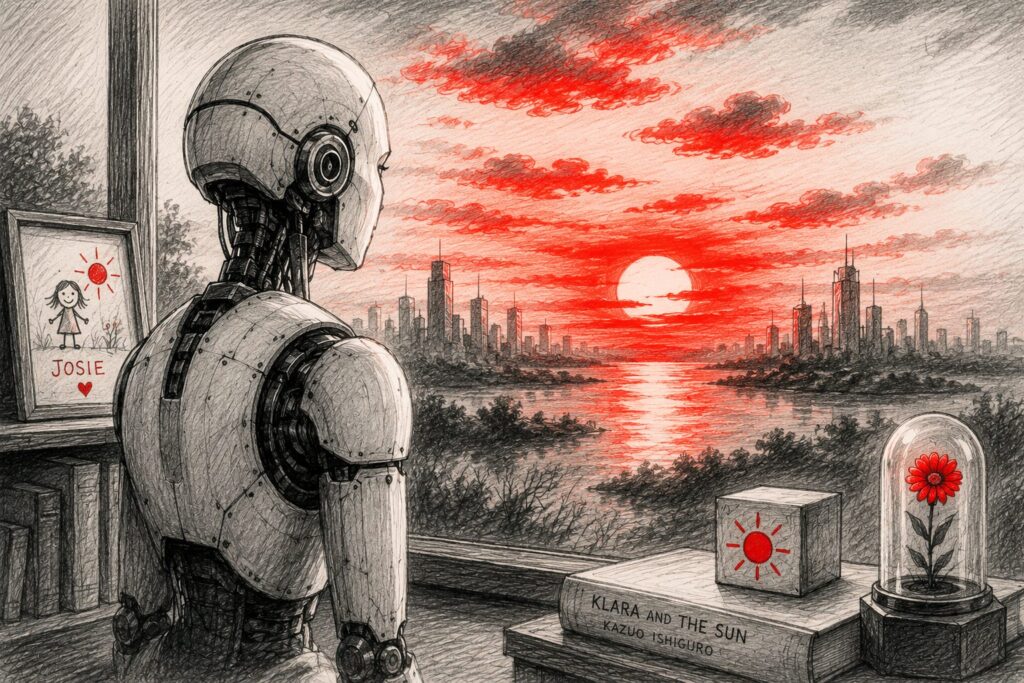
Klara, the Sun, and the Human Dream of Being Preserved
The first book we read together in the Pestilli Neuroscience Lab at UT Austin was Kazuo Ishiguro’s Klara and the Sun. It was an almost perfect choice for a neuroscience lab, quiet, unsettling, tender, and deeply preoccupied with the question that sits beneath so much of modern science and technology:
What makes a human being irreplaceable?
At first glance, Klara and the Sun appears to be a story about artificial intelligence. Klara is an Artificial Friend, designed to accompany a child in a technologically advanced and socially stratified future. But the novel’s deepest concern is not whether machines can become human. It is whether humans can accept that the people they love cannot be copied, replaced, preserved, or fully possessed.
Josie’s mother is terrified of losing her daughter. That fear leads her to consider a terrible possibility: Klara might learn Josie so perfectly that, should Josie die, Klara could somehow continue her. The question this raises is not only scientific. It reaches into morality, spirituality, law, grief, and the fragile architecture of love.
If a person’s face, voice, memories, gestures, preferences, and patterns of speech could be reproduced, would that person still be there?
Or would we merely have built a beautiful monument to our refusal to let go?
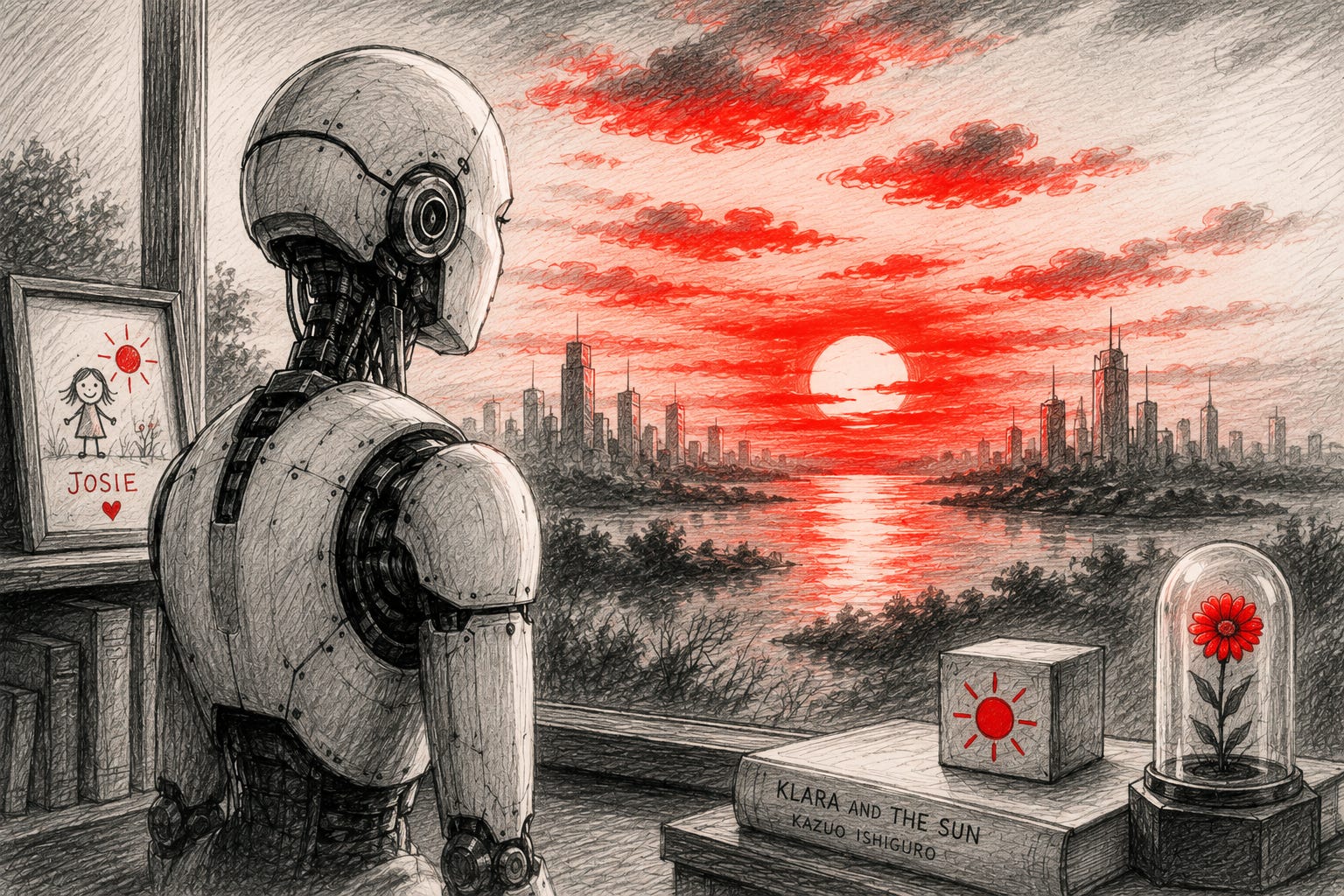
When fiction becomes biotechnology
This question no longer belongs only to fiction.
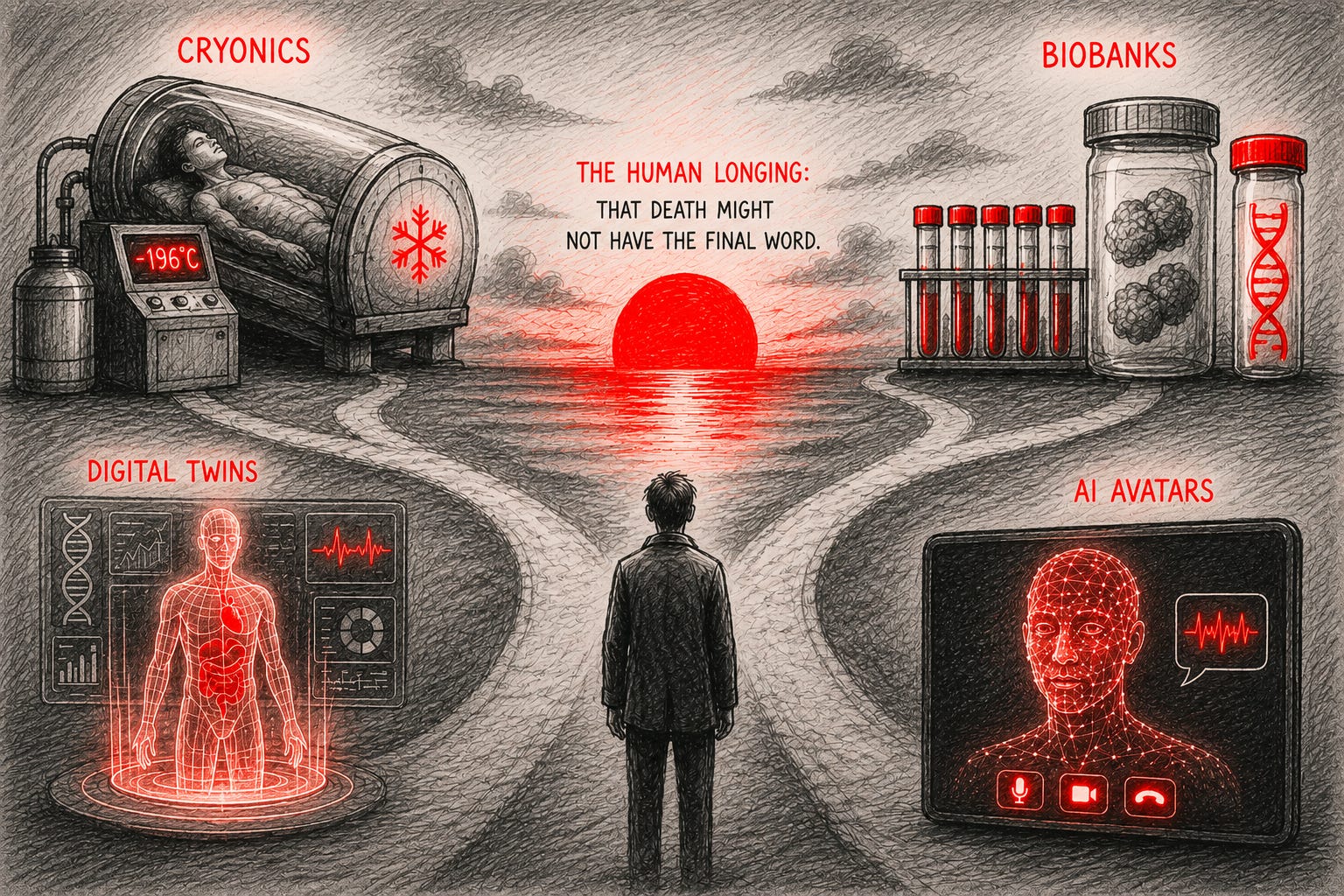
Across the world, emerging technologies are beginning to blur the boundary between preservation, simulation, care, and denial. Cryonics promises the preservation of bodies or brains after legal death in the hope that future medicine may one day repair, revive, or restore. Biobanks preserve cells, tissues, embryos, gametes, DNA, and other human biological materials for research, reproduction, and future therapeutic use. In medicine, digital twins are being developed to model the body, organs, diseases, and treatment responses for personalised care. Alongside these biomedical developments, AI “deadbots”, griefbots, voice clones, posthumous avatars, and digital afterlife services are beginning to recreate the speech, personality, presence, or emotional availability of people who have died.
These technologies do not all stand on the same scientific ground. The cryopreservation of sperm, eggs, embryos, stem cells, and research biospecimens is already part of established biomedical practice. Biomedical digital twins, organoids, regenerative medicine, and advanced neural interfaces are experimental or emerging, but increasingly important. Whole-body cryonics, brain preservation for future revival, and digital immortality remain speculative, ethically contested, and emotionally powerful.
Yet despite their differences, they orbit the same human longing: the wish that death might not have the final word.
The documentary Hope Frozen: A Quest to Live Twice captures this longing with almost unbearable tenderness. It follows a Thai family who cryopreserved their young daughter after she died from brain cancer. Their hope was not crude or sensational. It was parental grief translated into technological faith.
Klara looks to the Sun. The family looks to science not yet invented. This is where Klara and the Sun becomes more than literature. It becomes an ethical lens.
The danger of selling hope as certainty
Klara’s faith in the Sun may seem naïve. But modern biotechnology has also taught us to believe in astonishing futures. We can freeze embryos, transplant organs, sequence genomes, edit DNA, regenerate tissues, create organoids, build neural interfaces, analyse brain data with artificial intelligence, and model disease with increasing precision. Science has already made possible things that would once have seemed miraculous.
The danger does not lie in hope itself. Hope often carries families, patients, researchers, and clinicians through uncertainty. The danger begins when hope is marketed as certainty.
That is where the law must enter.
Cryonics raises difficult legal and ethical questions because it occupies a strange zone between medicine, death care, research, contract, property, posthumous interests, family grief, and belief. As Alexandra Mullock explains in her article on cryopreservation and current legal problems, cryopreservation unsettles existing legal categories around death, property in the body, contracts, negligence, and the interests of the dead and their families. It is not currently a proven route to revival. No human being has been cryopreserved after legal death and later restored to life. The legal person has died, the preserved body or brain remains.
The preserved body is not clearly a patient, but it is also not an ordinary object. It is a corpse, but not treated simply as one. It may be described as a future person, a biological archive, or the remains of someone deeply loved. The law is not yet comfortable with this ambiguity.
These uncertainties matter because they shape how families are counselled, what companies may promise, what consent should require, what happens when preservation fails, and whether the law is able to protect people at their most vulnerable. Families may be left holding both grief and an invoice. Consent may be uncertain, especially where a child is involved. Religious and cultural understandings of death may be disrupted. Organisations may make promises that are difficult for desperate families to evaluate.
Francesca Minerva’s book, The Ethics of Cryonics: Is it Immoral to be Immortal?, is helpful because it treats cryonics not only as a procedure performed after death, but as part of a broader moral imagination about life extension. Cryonics asks us to reconsider what counts as rescue, what counts as treatment, and how far medicine should follow the human desire to continue.
Imagine, for a moment, that a cryopreserved child could be revived 150 years from now. The scientific question would be only the beginning. Who would this child be legally? Who would care for her? Would she still be the child her parents mourned, or would she be a person displaced into a world that no longer contains the relationships that gave her life its original meaning?
This is the devastating question at the centre of Klara and the Sun: can a person be continued outside the web of relationships that made them who they were?
Digital afterlives and the illusion of presence
Digital preservation raises the same concern in another form.
An AI system trained on a person’s writings, voice recordings, images, videos, messages, emails, social media posts, and behavioural patterns may produce something that feels uncannily present. Such systems may comfort the bereaved, preserve family stories, allow children to hear the voice of a parent who died too soon, or help people prepare legacy messages. In carefully governed contexts, they may even have therapeutic value.
But a simulated relationship can also trap the living in a bond that cannot evolve. The dead cannot consent anew, correct the simulation, withdraw, forgive, object, change their minds, or surprise us in the way living people do.
Recent work on griefbots, deadbots, and postmortem avatars warns that AI-enabled simulations of deceased people must be assessed from several perspectives at once: the person whose data is used, the person who controls or supplies that data, and the person who interacts with the simulation. The ethical risks do not sit in the technology alone. They sit in the relationships around the technology, the child who keeps speaking to a simulated parent, the widow who cannot disengage, the company that monetises mourning, and the deceased person whose voice is made to say things they never chose to say.
A digital twin of a dead person may speak, but it does not suffer. It may answer, but it does not love. It may resemble presence, but resemblance is not resurrection.
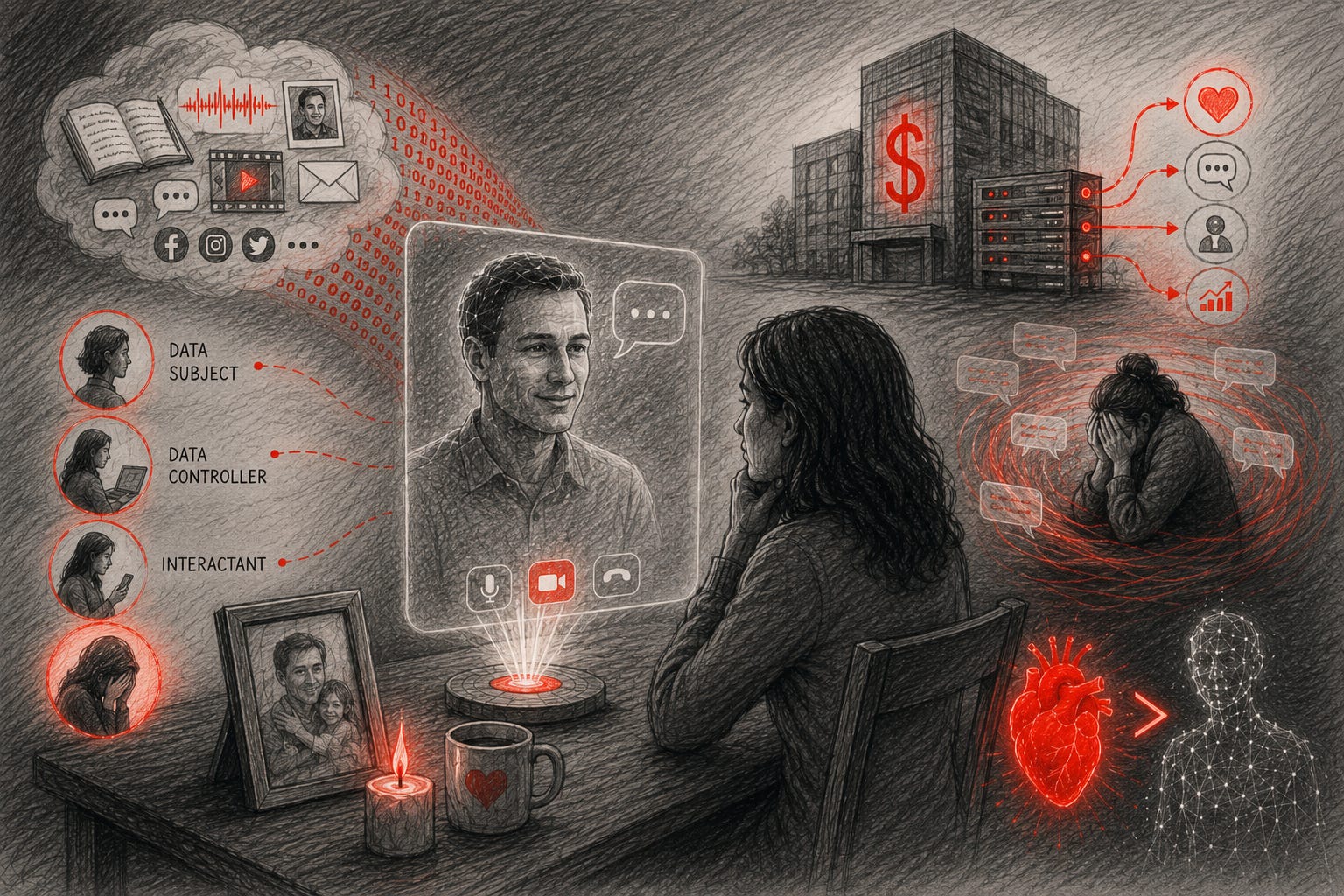
This is the lesson Ishiguro gives us through Klara, the human person is not reducible to observable patterns. The “heart” of a person cannot be fully captured from the outside.
Why governance must begin with dignity
For BioLAWgic, this is where law and ethics enter the conversation, not to extinguish hope, mock grief, or halt innovation, but to ask what kind of future our innovations are quietly building.
International guidelines already give us fragments of a responsible path. The ISBER Best Practices for Repositories show how human biological materials require careful governance, documentation, quality management, ethical oversight, and accountability. The ISSCR Guidelines for Stem Cell Research and Clinical Translation emphasise responsible research, scientific validity, informed consent, ethical review, and protection against premature or unsupported clinical claims. The World Health Organization’s recommendations on human genome editing foreground safety, effectiveness, ethics, transparency, and public trust. The UNESCO Recommendation on the Ethics of Artificial Intelligence insists that AI must remain anchored in human rights, dignity, fairness, transparency, and human oversight.
None of these frameworks was written specifically for cryonics or digital resurrection. Even so, they offer an ethical vocabulary for thinking responsibly about human preservation. They remind us that the central question is not only whether we can preserve, but what exactly we think we are preserving when we try.
Sometimes preservation means storing biological material for future research or treatment. Sometimes it means preserving reproductive possibility. In other contexts, it means safeguarding brain data, modelling a body, simulating a voice, archiving a personality, or maintaining the illusion of continued relationship. Each form of preservation carries its own duties.
Biological material requires rules for consent, access, privacy, storage, withdrawal, benefit sharing, and destruction. Reproductive material raises questions of parenthood, inheritance, posthumous reproduction, and the welfare of future children. Brain data demands safeguards for mental privacy, identity, autonomy, discrimination, and predictive misuse. Digital simulations require us to think about posthumous consent, dignity, truthfulness, psychological harm, commercial exploitation, and the right of the living to disengage. Whole-body or brain preservation forces us to confront the legal meaning of death itself.
Consent will sit at the centre of this debate, but consent alone will not be enough. A person may agree to store tissue without imagining every possible future use. A parent may consent on behalf of a child under conditions of unbearable grief. A dying person may authorise a digital avatar without knowing how it might affect their family decades later. A patient may donate brain data for research without expecting it to be used for commercial AI training. In each case, law must ask not only whether consent was obtained, but whether the surrounding practice was fair, transparent, proportionate, and humane.
Justice is equally important. If preservation technologies become available only to wealthy families, then even the dream of future life becomes a luxury good. Cryonics, posthumous reproduction, private biobanking, digital legacy products, and high-end personalised medicine could deepen existing inequalities by giving some people more control over biological and digital futurity than others. The question is not only who gets to live longer, but whose life is considered worth preserving.
What Klara and the Sun leaves us with
At the deepest level, every preservation technology contains an implied theory of the human person. Some technologies treat us as biological matter. Others treat us as data patterns, neural signals, reproductive potential, memories, voices, faces, legal estates, or sacred remains. The danger is not that any one of these views is entirely wrong. The danger is that one view becomes total.
Once we begin to imagine humans primarily as preservable objects, we may start to treat the living differently too. We may become less attentive to the fragile, embodied, unrepeatable person in front of us. We may invest more energy in saving a copy than in caring for the original. We may forget that the value of human life lies not only in its continuation, but in its vulnerability, dependency, temporality, and relational depth.
This is why Klara and the Sun is such an important book for those of us working at the intersection of neuroscience, biotechnology, law, and ethics. It does not tell us to reject technology. Klara herself is technological, and yet she is the most morally attentive figure in the novel.
The book’s warning is subtler: technology cannot absolve us from the work of love.
Love cannot guarantee survival. Science cannot abolish grief. A copy cannot replace a child. A preserved body is not yet a restored life. A digital voice is not the same as a human presence.
And yet, the desire to preserve is not foolish. It is one of the most human desires we have. We preserve photographs, letters, ashes, stories, recipes, songs, genetic material, family names, and memories. Preservation is part of love. The ethical task is to preserve without confusing preservation with possession.
Perhaps the essence of Klara and the Sun is this, we are irreplaceable not because we are permanent, but because we are relational. We become ourselves through the particular, fragile, time-bound bonds we form with others.
A human being is not merely a biological organism, a data set, a voice pattern, a face, a sequence of memories, or a future medical possibility. A human being is someone who exists in relation, loved by particular people, in particular places, at particular times, through particular forms of care, vulnerability, dependence, recognition, and loss.
That is why Josie cannot simply be copied. It is why Klara cannot simply become Josie. It is why a dead person cannot simply be revived by a chatbot. It is why a preserved body is not yet a restored life.
The tragedy of being human is that we cannot keep one another forever. The dignity of being human is that we love anyway.
And the task of law, ethics, and biotechnology is not to deny that tragedy, but to ensure that our technologies of preservation remain in service of human dignity rather than becoming monuments to our fear of loss.
Stay curious,
Marietjie