
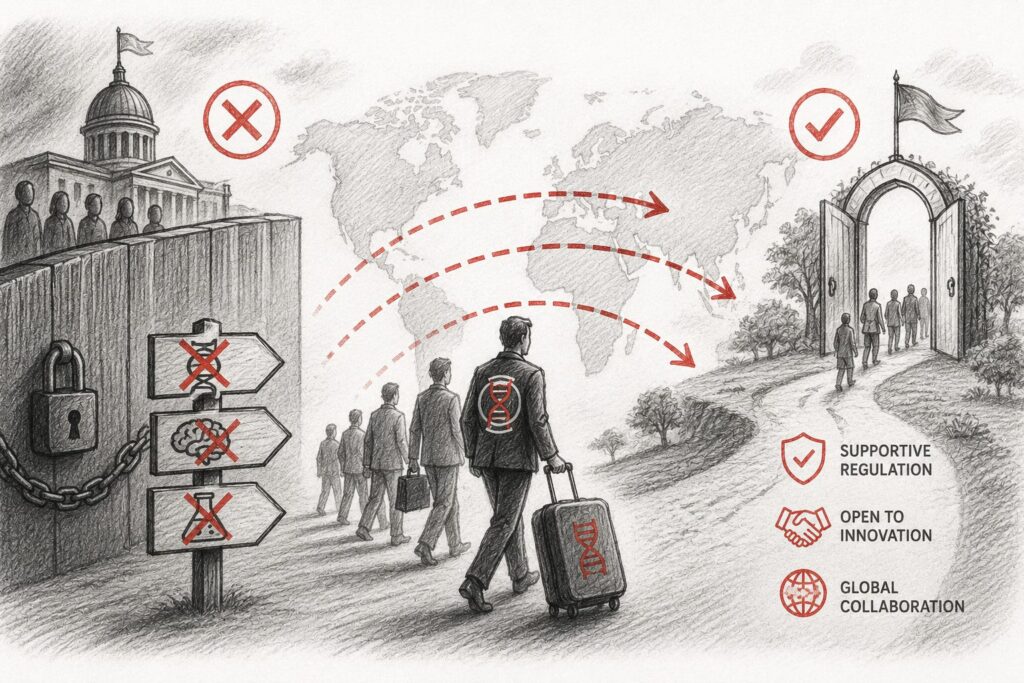
When Innovation Chooses Its Government: Regulatory Arbitrage and the Future of Human Genome Editing
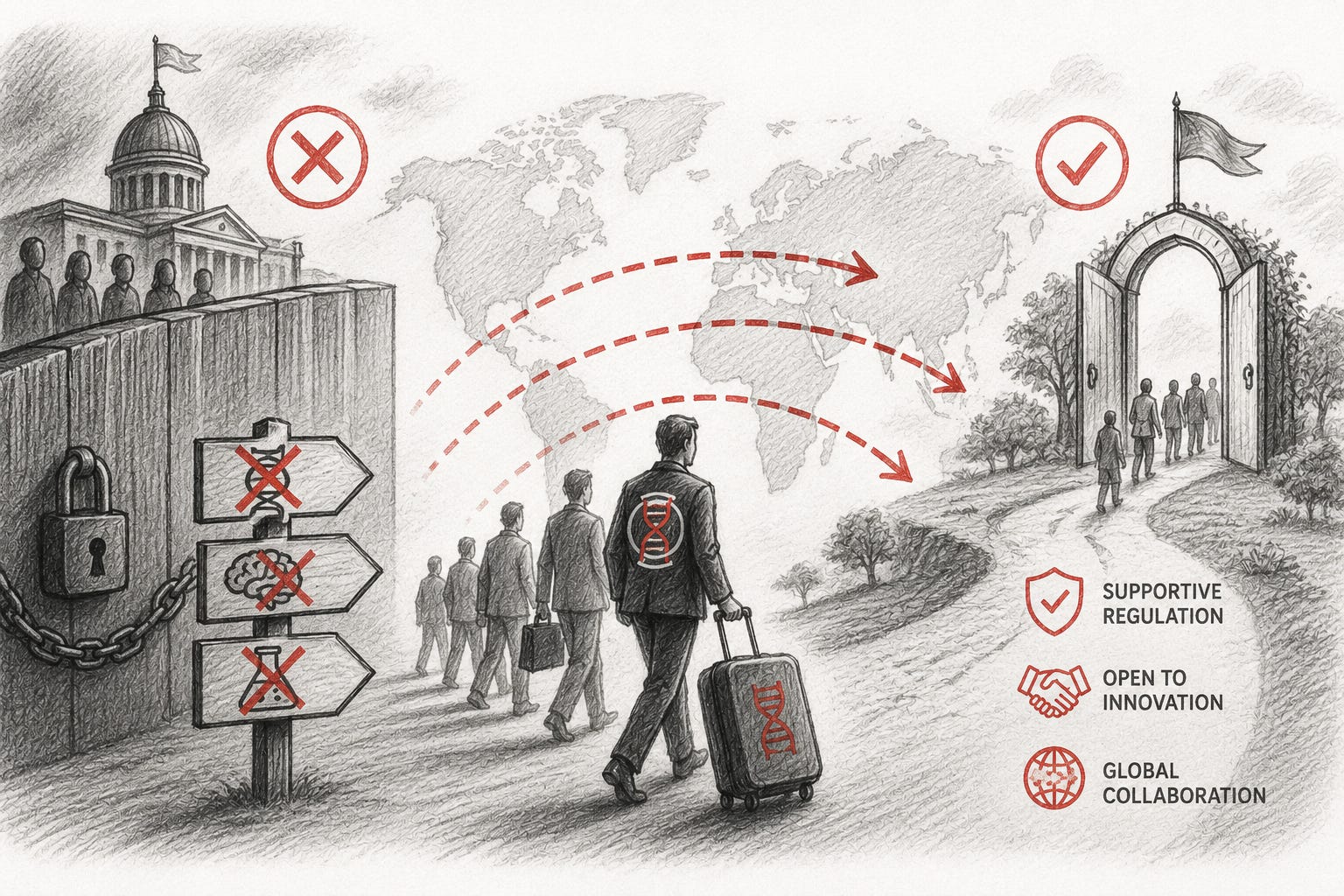
For centuries, governments decided which technologies could be developed within their borders. Today, we may be witnessing the beginning of a profound reversal. Increasingly, it is not governments choosing innovation. It is innovation choosing governments.
That possibility struck me while reading reports that Preventive, a biotechnology company reportedly backed by Sam Altman, had explored conducting future embryo gene-editing research outside the United States. Whether those reports ultimately prove significant is almost beside the point. What fascinated me was not the company itself. It was what the discussion revealed.
Perhaps one of the most important governance challenges of the next generation of biotechnologies will not be whether governments permit innovation. It will be whether companies can simply choose another government.
The Great Inversion
For most of modern history, governance worked in one direction. Governments enacted laws. Scientists operated within them. Companies complied. Innovation followed.
Today, that relationship is becoming more complicated. Capital moves. Researchers move. Clinical trials move. Data moves. Companies move. Increasingly, governance itself has become part of the competitive landscape. Countries are no longer competing only through taxation, research funding, or infrastructure. They are beginning to compete through governance.
Different jurisdictions are developing very different approaches to emerging technologies such as heritable human genome editing (HHGE), artificial intelligence, neurotechnology, and advanced reproductive medicine. Some favour precaution. Others seek to accelerate innovation. Others remain largely unregulated. For companies operating at the scientific frontier, these differences matter enormously.
When Governance Becomes Part of the Market
Law has traditionally been understood as the framework within which markets operate. But what happens when governance itself becomes a market variable?
A biotechnology company deciding where to establish a research programme may compare far more than tax incentives or laboratory facilities. It may evaluate ethical review processes, clinical trial pathways, data protection laws, intellectual property regimes, investment environments, regulatory certainty, public acceptance, and government support for innovation.
In other words, companies may increasingly compare governance systems themselves. This is often described as regulatory arbitrage, taking advantage of differences between regulatory frameworks.
But I wonder whether something broader is beginning to emerge.
Perhaps we are entering an era of governance competition, where entire governance ecosystems become part of a country’s innovation strategy.

Human Genome Editing Is Only the Beginning
Heritable human genome editing (HHGE) provides perhaps the clearest illustration of this emerging governance challenge.
Following the birth of the CRISPR-edited babies in China in 2018, governments around the world responded in markedly different ways. Rather than converging around a single regulatory model, countries have continued to develop diverse legal and policy approaches reflecting different ethical traditions, constitutional values, and political priorities.
Some jurisdictions have adopted highly restrictive approaches. Canada, for example, prohibits clinical germline genome editing through the Assisted Human Reproduction Act, making it a criminal offence to knowingly alter the genome of a human cell or embryo in a manner capable of being inherited by future generations. Similarly, Germany’s Embryo Protection Act (Embryonenschutzgesetz) remains among the world’s most restrictive legal frameworks governing research involving human embryos. An overview of Germany’s regulatory framework is available through the German Ethics Council.
Other jurisdictions have adopted a more nuanced approach by distinguishing between research and clinical application. The United Kingdom, through the Human Fertilisation and Embryology Authority (HFEA) , permits licensed research involving genome editing of human embryos under strict regulatory oversight, provided that edited embryos are never implanted and are destroyed within the statutory research period. The HFEA’s licensing framework for genome-editing research is described in its Research Regulation Guidance. Australia follows a comparable model under the Research Involving Human Embryos Act 2002 and the Prohibition of Human Cloning for Reproduction Act 2002, permitting carefully regulated embryo research while continuing to prohibit the clinical use of genome-edited embryos intended to establish a pregnancy.
These examples illustrate an increasingly diverse regulatory landscape in which countries are making fundamentally different policy choices about the same emerging technology.
Interestingly, this growing diversity has emerged despite sustained international efforts to encourage greater regulatory convergence.
Following the 2018 events in China, several international organisations sought to develop common governance principles that could guide states while respecting national sovereignty. In 2021, the World Health Organization (WHO) published its landmark Human Genome Editing: Recommendations together with the Human Genome Editing: A Framework for Governance, calling for greater international cooperation, transparency, public engagement, responsible oversight, and mechanisms to discourage unethical research.
Similarly, UNESCO’s International Bioethics Committee (IBC) has consistently urged extreme caution regarding heritable human genome editing and has previously advocated for a global moratorium on clinical germline genome editing. UNESCO’s foundational principles are contained in the Universal Declaration on the Human Genome and Human Rights, while its bioethics activities are coordinated through the UNESCO Bioethics Programme.
The International Commission on the Clinical Use of Human Germline Genome Editing, convened jointly by the U.S. National Academy of Medicine, the U.S. National Academy of Sciences, and the Royal Society, likewise concluded that clinical applications should proceed only if exceptionally stringent scientific, ethical, and governance criteria can be satisfied.
These initiatives all share a common objective:
to promote greater international coherence in the governance of genome editing.
Yet there is an inherent limitation.
Unlike national legislatures, international organisations cannot enact binding laws for sovereign states. They can recommend, advise, coordinate, and encourage harmonisation, but implementation ultimately depends on domestic legislation, regulatory agencies, and political will.
The result is a fascinating paradox.
As international organisations work towards greater global convergence, national regulatory landscapes continue to diversify.
It is precisely this growing divergence, not merely differences in scientific capability, that creates the conditions under which regulatory arbitrage may emerge. If one jurisdiction prohibits a particular application of HHGE while another permits carefully regulated research, companies, investors, researchers, and even patients may increasingly choose to relocate to the governance ecosystem that best aligns with their scientific and commercial objectives.
The governance question therefore shifts.
It is no longer simply:
Should a country permit heritable human genome editing?
It becomes a far more difficult constitutional question:
Can national governance remain effective when scientific innovation itself has become transnational?
Beyond Genome Editing
The implications extend far beyond HHGE.
Imagine future brain-computer interfaces capable of enhancing memory or cognition. Imagine neurotechnologies that decode aspects of human thought. Imagine artificial intelligence systems that continuously analyse neural data. Imagine future reproductive technologies integrating genomics, artificial intelligence, and predictive analytics. Will companies developing these technologies always remain within jurisdictions that impose the highest ethical standards? Or will they increasingly establish research programmes where regulatory pathways are more favourable?
The technology may change. The governance question will not.
A Constitutional Challenge
This is where I believe the discussion becomes particularly interesting.
My own research has explored the idea of digital constitutionalism, the recognition that constitutional values such as dignity, privacy, autonomy, equality, and accountability must increasingly operate beyond traditional state institutions in digital environments. Perhaps the same challenge is now emerging in biotechnology. Constitutional systems were designed around territorial authority. Yet frontier technologies increasingly operate across borders.
If governance remains primarily national while innovation becomes fundamentally global, then one of the central assumptions of constitutional governance begins to shift.
The challenge may no longer be simply regulating technologies. It may be governing technologies whose developers can choose the jurisdictions in which they operate.

The Question We Should Be Asking
The debate surrounding companies such as Preventive is therefore much larger than a single start-up or a single technology. It forces us to confront a deeper question.
Who governs the future when innovation can choose its government?
That question reaches far beyond genome editing. It applies equally to neurotechnology, artificial intelligence, digital health, synthetic biology, and whatever transformative technology emerges next.
Perhaps the defining governance challenge of the twenty-first century will not be regulating innovation. It will be ensuring that democratic values, human rights, and responsible governance remain meaningful in a world where innovation itself has become increasingly mobile.
Stay curious,
Marietjie